
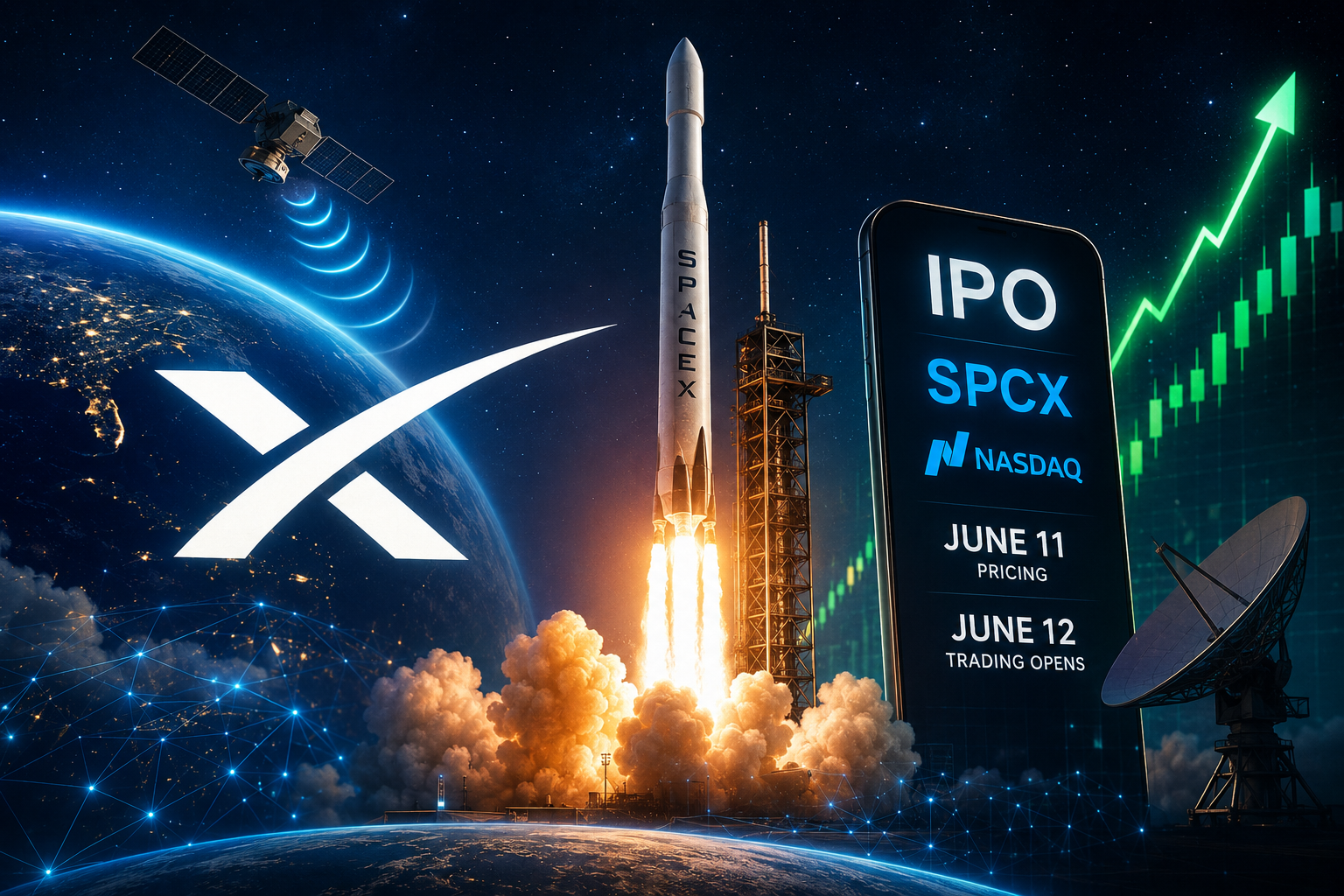
In 17 days, the largest initial public offering in the history of financial markets will begin trading on the Nasdaq. SpaceX — officially filing as SPCX — is targeting a $1.75 trillion valuation when it prices on June 11 and opens for trading on June 12. For context: that’s nearly six times the size of Saudi Aramco’s $29 billion IPO in 2019, which was previously the largest ever.
This isn’t just a milestone for Elon Musk. It may reshape how capital flows across the entire equity market — and for the first time in a float of this scale, retail investors have a direct path in at IPO price.
Here’s what you need to understand before the opening bell on June 12.
What You’re Actually Buying
SpaceX is no longer just a rocket company. The S-1 filed with the SEC on May 20 reflects a combined entity that now includes three distinct businesses under one ticker:
SpaceX Launch — the core rocket business, with Falcon 9 and the Starship platform. This is the world’s dominant commercial launch provider by flight frequency and payload capacity.
Starlink — the satellite internet division, now providing broadband to tens of millions of subscribers globally. This is the revenue engine. Starlink’s recurring subscription model gives SPCX a cash-flow profile that pure aerospace companies have never had.
xAI — Elon Musk’s artificial intelligence company, merged into SpaceX in February 2026. This is the wild card. xAI is pre-revenue at meaningful scale, and bundling it into the IPO means retail investors are being asked to value a nascent AI venture alongside two mature aerospace and telecom businesses — all at a combined $1.75 trillion.
That’s an important nuance. SPCX is not a pure-play on anything. It’s three different investment theses priced as one.
The Numbers That Matter
SpaceX is raising approximately $75 billion through this offering — not from existing shareholders cashing out, but as fresh capital going into the business.
At $1.75 trillion, the company is being valued at roughly the same level as the entire market cap of Amazon as of early 2026. Whether that valuation is justified depends almost entirely on how fast Starlink can scale revenue and how much of xAI’s potential the market is willing to price in today.
The IPO will be the single largest equity capital raise in history. That matters not just symbolically: at this size, index funds will be forced to buy SPCX for passive exposure, creating automatic institutional demand on day one.
The Retail Angle: You Can Actually Get In at IPO Price
Here’s what makes this IPO genuinely different for everyday investors.
SpaceX has allocated 30% of shares directly to retail through Robinhood, Fidelity, and Charles Schwab. That is the largest direct-to-retail carve-out ever offered in a mega-IPO. Historically, the biggest offerings were gatekept almost entirely by institutional allocations — retail investors could only buy on the secondary market after the price had already popped.
If you have an account at any of those three platforms, watch for allocation details to be published before June 11. Demand is expected to far exceed supply, so allocations may be lottery-based or capped per account.
The Governance Risk You Need to Understand
This is where informed retail investors need to read carefully.
Elon Musk holds approximately 42% of SpaceX’s equity — worth roughly $735 billion at the IPO valuation. More importantly, he controls 85.1% of voting power through Class B shares, which carry 10 votes each versus 1 vote for the Class A shares being offered to the public.
In practice, this means no board vote, no shareholder resolution, and no governance decision can go against Musk’s wishes. If you buy SPCX, you are not buying influence or representation in the company. You are buying economic exposure to its growth — with zero say in how it’s run.
That’s not inherently a dealbreaker. Apple shareholders had a similar dynamic with Steve Jobs. But it is a structural risk that’s worth pricing into your thinking, especially given the xAI merger, which added a pre-revenue AI company to the balance sheet without a separate shareholder vote.
The Bottom Line
The SpaceX IPO is a legitimate historic event — in terms of size, the retail access it offers, and the range of businesses now bundled under SPCX. For long-term investors who believe in Starlink’s revenue trajectory and are comfortable with the Musk governance structure, this is a rare chance to get in at the offering price rather than chasing a post-IPO spike.
But go in clear-eyed: at $1.75 trillion, a significant portion of SpaceX’s potential growth is already priced in. You’re also getting xAI whether you want it or not.
Pricing is June 11. Trading opens June 12, Nasdaq, ticker SPCX.
Sources: SpaceX IPO Date Set for June 12 — TradingKey | SpaceX Targets June 11 IPO Pricing — CoinDesk | SPCX: Everything You Need to Know — PurePowerPicks | SpaceX IPO 2026: Valuation, Musk Math & xAI Risks — IndMoney