
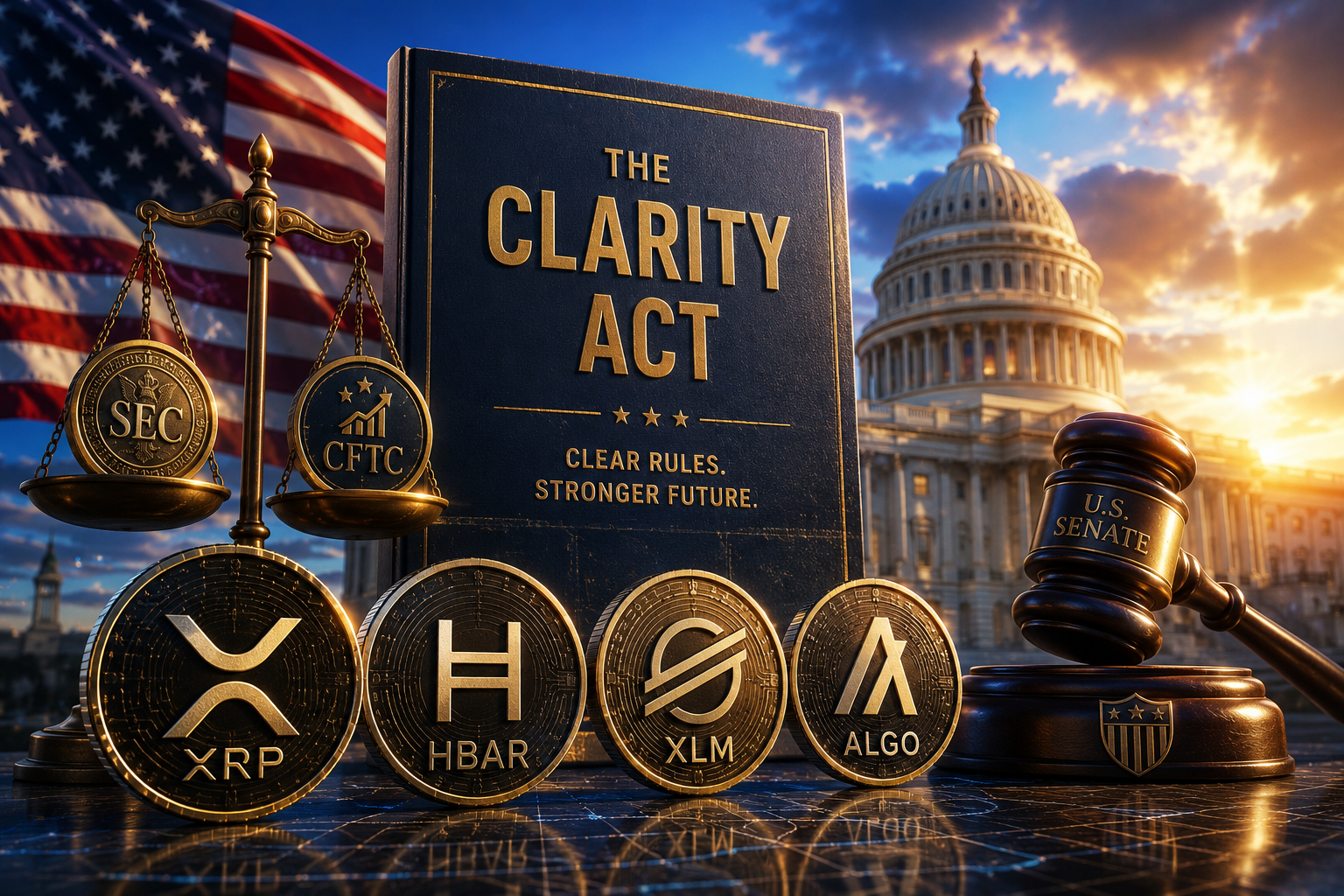
Two weeks ago, something happened in Washington that didn’t get nearly enough mainstream attention outside of crypto circles. The Senate Banking Committee voted 15-9 to advance the Digital Asset Market Clarity Act — commonly called the CLARITY Act — out of committee and onto the path toward a full Senate floor vote.
That number, 15-9, matters more than it looks. This wasn’t a party-line rubber stamp. Two Democratic senators — Ruben Gallego of Arizona and Angela Alsobrooks of Maryland — crossed the aisle to vote yes. In the current political climate, that’s not a small thing. Bipartisan support is the difference between a bill that gets used as a fundraising talking point and one that actually has a shot at becoming law.
July 4 is being quietly floated in Washington circles as a target signing date. Whether that’s realistic or optimistic will become clearer over the next few weeks, but the direction of travel is not ambiguous. The most significant piece of crypto legislation in U.S. history is closer to the finish line than it has ever been. If you hold XRP, HBAR, XLM, or ALGO — or you’re following any of the ISO 20022-compliant assets — you need to understand what this bill does, why it matters, and what still stands between here and the President’s desk.
What the CLARITY Act Actually Does
Let’s start with the core mechanics, because a lot of the coverage has been vague on the specifics.
The CLARITY Act draws a regulatory boundary that the crypto industry has been fighting for since roughly 2017. It creates two distinct legal categories for digital assets: investment contract assets and digital commodities.
Investment contract assets remain under SEC jurisdiction. These are digital assets sold in a fundraising context where buyers have a reasonable expectation of profit based on the efforts of a centralized team — the classic Howey Test application. If the network is still being built and a core team controls the roadmap, the SEC has a claim.
Digital commodities fall under CFTC exclusive jurisdiction over spot markets. These are assets where the underlying network is “sufficiently decentralized” — meaning no single entity controls the protocol and the asset functions more like a commodity (think oil, gold, or Bitcoin) than a company stock.
The practical effect of this distinction is enormous. XRP, HBAR, XLM, and ALGO have each spent years operating under a cloud of regulatory uncertainty created largely by the SEC’s refusal to define whether they were securities. The CLARITY Act ends that ambiguity. Under the bill’s framework, these assets would be classified as digital commodities and placed under CFTC oversight — effectively locking the SEC out of their spot markets permanently.
For XRP specifically, this would represent the final chapter of a legal saga that began in December 2020, when the SEC sued Ripple alleging it had sold unregistered securities for nearly a decade. Even after a 2023 court ruling found that secondary market sales of XRP did not constitute securities transactions, the regulatory status of the asset remained technically unresolved. The CLARITY Act resolves it at the legislative level.
The HBAR Situation Is More Interesting Than Most People Realize
The passage of the CLARITY Act matters for all of the ISO 20022-compliant assets, but the HBAR story is worth isolating because it illustrates the financial stakes most clearly.
As of this week, there are 15 active HBAR ETF filings under SEC review — including applications from Grayscale and Bitwise, two of the most credible institutional names in the space. More immediately, Canary Capital’s HBAR Spot ETF is already listed and trading, with the fund holding approximately 549 million HBAR. It posted a $240,000 net inflow on May 22 alone — modest in absolute terms, but notable because it represents institutional money moving into a spot HBAR product that barely existed a year ago.
The CLARITY Act matters to this picture because the current ETF review process is happening under a regulatory framework that is still technically ambiguous about HBAR’s legal status. SEC approval of a spot HBAR ETF carries more legal risk for the agency right now than it would under CLARITY Act conditions, where HBAR’s commodity classification would be statutory. Once the bill passes, the remaining 15 pending filings have a dramatically cleaner path to approval. The institutional capital waiting in those queues is not small.
The XRP Wildcard: RLUSD and the Warren Factor
Nothing about the XRP story is ever simple, and this week is no exception.
On May 18, Senator Elizabeth Warren sent a letter to the Office of the Comptroller of the Currency demanding records related to Ripple’s RLUSD stablecoin by June 1. Warren has been one of the most vocal critics of crypto in the Senate for years, and the RLUSD challenge is consistent with her broader position — but the timing, arriving just two weeks after the CLARITY Act advanced out of committee, is pointed.
RLUSD is Ripple’s dollar-pegged stablecoin, and it sits in a different regulatory category than XRP itself. Stablecoins are addressed separately under the broader crypto legislative landscape, and Warren’s letter appears designed to create friction around Ripple’s ecosystem expansion even as the path for XRP itself is getting clearer.
This is worth watching because it introduces some real tension. The CLARITY Act could definitively resolve XRP’s commodity status while RLUSD simultaneously faces a separate, ongoing regulatory challenge. For XRP holders, these are distinct issues — but they share a narrative, and the latter could muddy the public and political reception of the former if the timing gets messy.
Meanwhile, on the protocol side: XRPL v3.2.0 and the Lending Protocol upgrade are expected to launch on the XRP Ledger in the May–June window. This is the largest functional upgrade to the XRP Ledger in the current cycle, introducing native on-chain lending. Network development is proceeding on its own timeline regardless of how the legislative picture unfolds, which matters for long-term fundamental evaluations of the asset.
What Still Stands Between Here and Law
The CLARITY Act clearing the Senate Banking Committee is significant, but it would be wrong to treat it as a done deal. There are real obstacles remaining, and intellectual honesty requires acknowledging them.
The first is the government ethics provision. One of the more contentious elements of the bill’s ongoing negotiations involves limits on government officials’ ability to participate in the crypto industry — a provision aimed squarely at the Trump administration’s multiple crypto-adjacent business interests. This has been a sticking point in bipartisan negotiations, and it could pull Democratic support if not resolved carefully.
The second is anti-money-laundering provisions. Senate Democrats have pushed for stronger AML and DeFi compliance language than the current bill includes. How much the final text moves on this will determine whether the bill can hold its bipartisan support through a full floor vote.
The third is simply time. August has been cited as a realistic drop-dead window before the political calendar gets consumed by other priorities. The bill still needs to pass the full Senate and reconcile with any House version before heading to the President’s desk. That’s not impossible in the given timeframe, but it requires sustained political will from both parties.
Today also marks the last day before the FOMC blackout period begins (May 29–June 10), and this morning’s April PCE data — the Fed’s preferred inflation gauge, expected to come in near 3.9% headline — is a reminder of the macro environment in which all of this is happening. A Fed that is paralyzed by energy-driven inflation and unable to cut rates is a Fed that makes the case for regulated, dollar-adjacent digital payment rails more compelling, not less.
What This Means for Investors in ISO 20022 Assets
If you’re holding any of the assets most directly affected by the CLARITY Act — XRP, HBAR, XLM, ALGO, QNT — here is a grounded way to think about where things stand.
The regulatory risk that suppressed these assets for years is genuinely diminishing. The CLARITY Act’s bipartisan advancement isn’t a guarantee, but it is the most concrete legislative progress the space has seen. The price suppression created by legal uncertainty has been real and measurable. As that uncertainty resolves, the discount associated with it should logically compress.
Institutional access is opening in parallel. The HBAR ETF pipeline is not waiting for CLARITY Act passage — it’s moving forward under the current regulatory environment. Fifteen filings in queue is a strong signal of institutional demand that is positioning ahead of, not after, regulatory clarity. This is how early institutional adoption cycles tend to work.
Don’t conflate asset-level progress with project-level risk. The RLUSD situation is a reminder that even a legislatively clarified asset can carry project-specific risk. XRP and RLUSD are distinct instruments. The CLARITY Act improves the outlook for XRP as a digital commodity; it doesn’t resolve everything happening in Ripple’s broader corporate and regulatory orbit. Evaluate them separately.
The CLARITY Act isn’t law yet. But two weeks ago, it cleared a hurdle that would have seemed optimistic to even its most enthusiastic supporters two years ago. The direction of travel is clear. The only real question now is whether Congress can execute before August.