
If you spent the week of May 25 watching headlines about geopolitics and Fed policy, you may have missed the most important story playing out in plain sight: the AI investment thesis just got its clearest confirmation yet, and it came from the software sector’s earnings reports.
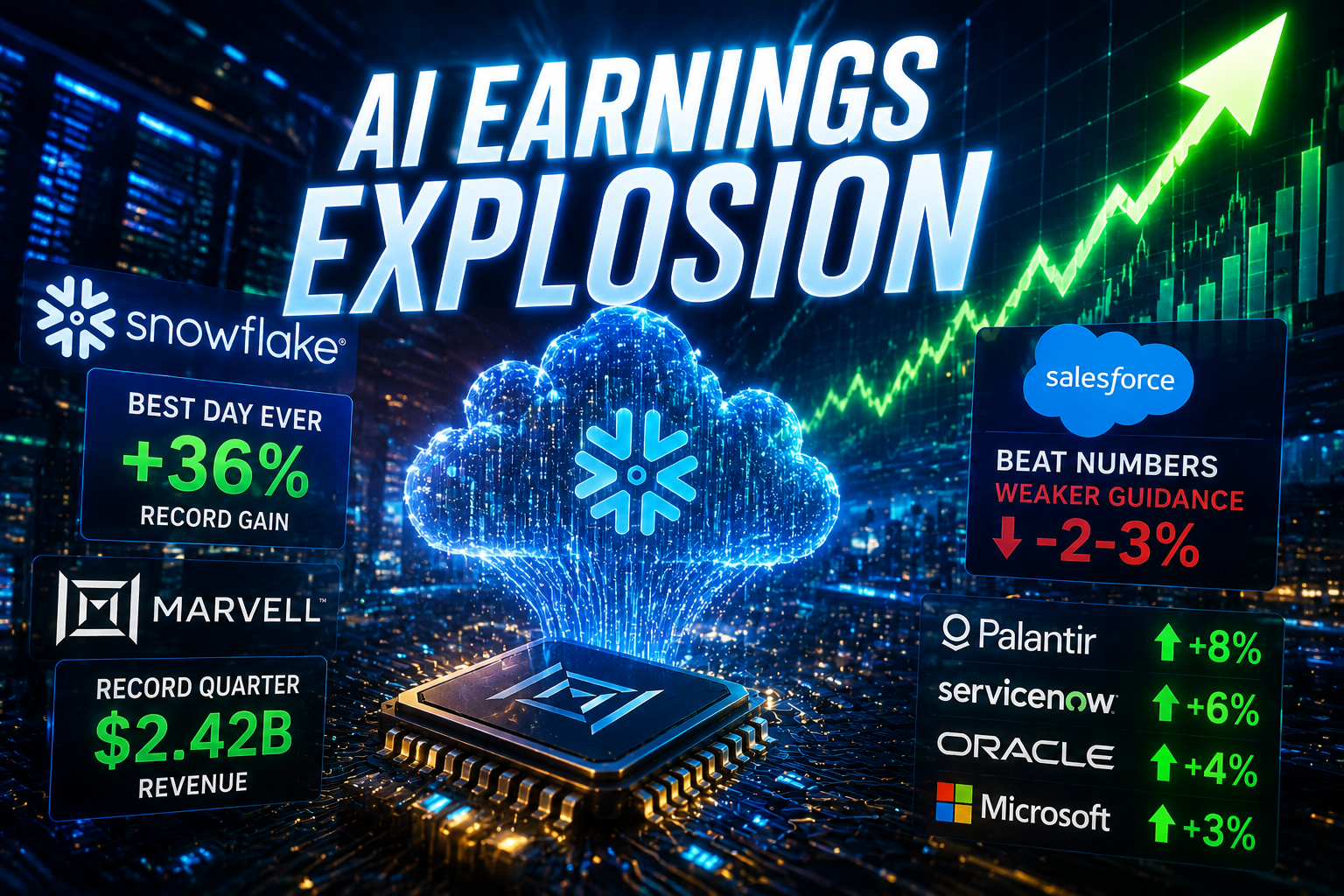
Snowflake posted the best single trading day in its history. Marvell Technology set an all-time revenue record. And a wave of AI-adjacent stocks — Palantir, ServiceNow, Oracle, Microsoft — rode the momentum higher. Meanwhile, Salesforce offered a cautionary counterpoint: beat the headline numbers, guide conservatively, and the market will punish you regardless.
Taken together, this week’s earnings painted a detailed picture of exactly which companies are winning the AI buildout — and which ones are still trying to figure out how to charge for it.
Snowflake: A $6 Billion Deal and the Best Day in Company History
Let’s start where the week ended, because Thursday evening’s Snowflake print was the kind of report that resets expectations for an entire sector.
The cloud data company reported first-quarter revenue of $1.39 billion, up 33% from a year ago and ahead of Wall Street’s $1.32 billion estimate. Earnings came in at $0.39 per share on an adjusted basis, well above the $0.32 consensus. Net revenue retention — a metric that tracks how much existing customers are spending compared to a year ago — climbed to 126%, its first increase after three consecutive quarters stuck at 125%. That’s the kind of number that tells you the upsell cycle is alive and accelerating.
But the number that really moved the stock wasn’t on the income statement. It was the announcement of a six-billion-dollar, multiyear compute deal with Amazon Web Services. That agreement is a signal, not just a contract: Snowflake is betting its future on becoming the data and AI layer that sits on top of the cloud — and Amazon is betting alongside it.
Shares closed up 36% on Thursday, the largest single-day gain in Snowflake’s history, moving from around $175 to more than $238. The company also raised its full-year product revenue guidance to $5.84 billion, implying 31% growth at that scale.
For retail investors: this is what it looks like when an AI infrastructure play actually delivers. Not promises — $6 billion in committed compute, 33% revenue growth, and customers spending more quarter over quarter.
Marvell: The Chip Company Nobody Talks About Enough
While Snowflake grabbed the headlines, Marvell Technology quietly reported the best quarter in its history.
First-quarter revenue came in at $2.418 billion, a record, and up 28% year-over-year. Non-GAAP earnings per share were $0.80. The driver? Custom AI chips — the silicon designed specifically for large-scale AI inference and training workloads at hyperscalers like Amazon, Google, and Microsoft.
Marvell doesn’t make chips for your laptop. It makes the networking, storage, and custom compute silicon that keeps data centers running at scale. As AI model training and deployment require more and more compute, Marvell sits in the supply chain at a point that’s hard to displace. The record revenue this quarter is a direct reflection of that demand.
The stock had already moved ahead of the print on strong analyst expectations, but the results confirmed what the smart money was pricing in: AI infrastructure spending is not slowing down.
Salesforce: A Beat That Didn’t Feel Like One
Not everything was celebration this week. Salesforce’s results on Wednesday illustrated the other side of the AI trade — and it’s a useful lesson.
The company reported first-quarter revenue of $11.1 billion, up 13% from a year ago, and adjusted earnings of $3.88 per share — well ahead of the $3.13 consensus estimate. By any traditional measure, that’s a strong beat.
The problem was the guidance. Salesforce’s outlook for the current quarter came in softer than analysts expected, and the stock fell roughly 2-3% in after-hours trading. Not a collapse, but a signal.
Here’s what the market is telling you: beating a number is table stakes right now. Investors want to see the AI narrative translate into accelerating revenue growth — not just better-than-expected margins on existing business. Salesforce is one of the most widely used enterprise software platforms in the world, but the question of how much incremental revenue its AI features (bundled under the “Agentforce” product line) will generate at scale remains open. The guidance didn’t close that question convincingly.
Compare that to Snowflake, which raised full-year guidance after beating estimates, or Marvell, whose business is structurally tied to AI infrastructure spend. The market is drawing a clear line between companies riding the AI tailwind and companies waiting to see if the wind blows their way.
The Spillover: Who Else Moved
Snowflake’s report triggered a broader software rally on Thursday. ServiceNow gained more than 6%. Palantir jumped around 8%. Oracle and Microsoft each added roughly 3-4%. These aren’t unrelated moves — investors read Snowflake’s results and immediately re-rated other companies they believe are in the same lane.
Palantir’s gains are notable because the company reports separately and has been one of the most volatile AI plays in the market. But each time a peer like Snowflake confirms real AI-driven revenue growth, it removes a layer of skepticism from the broader category.
What to Watch Going Into Next Week
NASDAQ futures are slightly lower Friday morning — down about 0.2% — but that looks like routine profit-taking after a week of outsized gains, not a sign of structural weakness. The S&P 500 and NASDAQ 100 both notched records this week.
Earnings season is effectively wrapping up now. Next week’s focus shifts back to macro: Fed Chair Kevin Warsh (who took office May 15) will be navigating a fresh set of data against a PCE reading that just came in at 3.8% year-over-year — the highest since May 2023. Rate cuts remain off the table through 2026, and some traders are beginning to price the possibility of a hike in early 2027.
The AI infrastructure trade looks durable. The “AI promise, monetization TBD” trade is getting harder to sustain.
The Bottom Line
This week’s earnings season coda answered a question that has hung over the market all year: is enterprise AI spend real, or is it a narrative?
Snowflake’s $6 billion AWS deal says it’s real. Marvell’s record revenue says the silicon to run it is flying out the door. The 126% net revenue retention at Snowflake says customers aren’t just buying — they’re buying more. And the spread between Snowflake’s reaction and Salesforce’s tells you exactly what the market wants to see: not just AI features, but AI revenue.
For retail investors watching this sector, the framework that’s emerging is straightforward: follow the compute. Companies with direct exposure to AI infrastructure buildout — chips, data platforms, networking — are where the earnings are confirming the story. Companies selling AI-powered software into enterprise workflows still have something to prove.