
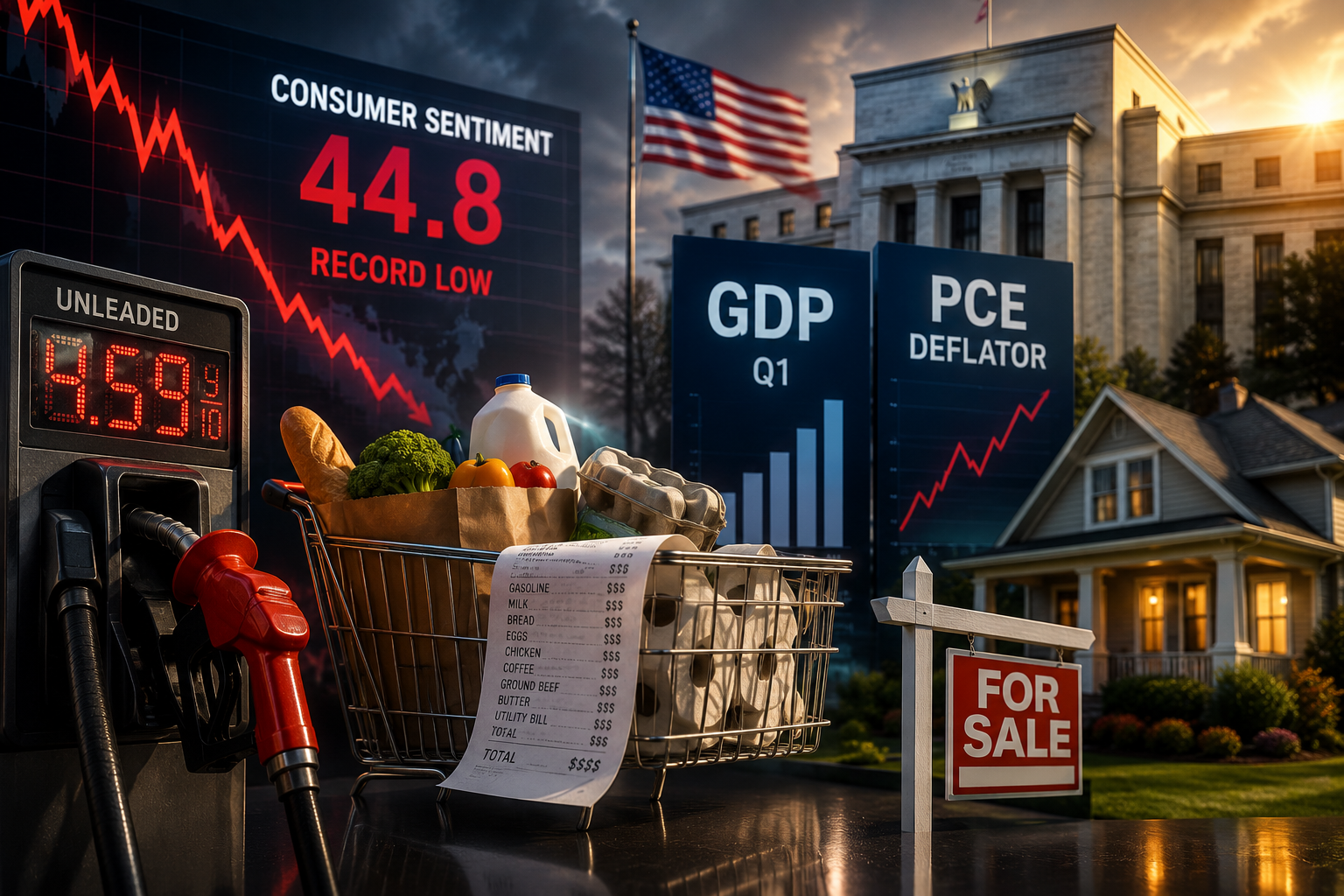
American consumers are losing confidence at a pace not seen in years. The University of Michigan’s Consumer Sentiment Index dropped to 44.8 in May — the third consecutive monthly decline, and a reading that now sits at a record low. That’s down from 49.8 in April and part of a sustained slide that began earlier this year when supply disruptions in the Strait of Hormuz started pushing gasoline prices higher.
This morning brings two data points that will either deepen or complicate that picture. At 10:00 AM ET, the Census Bureau releases April New Residential Sales, and the Richmond Fed publishes its May Manufacturing Survey — both fresh reads on whether the consumer pullback is spreading into housing and industrial activity. Then tomorrow morning, the bigger print lands: Q1 GDP (second estimate) and the PCE Deflator, the Federal Reserve’s preferred inflation gauge. That sequence — sentiment, housing, GDP, PCE — tells a complete story about where the U.S. economy stands right now. Today is chapter one.
What 44.8 Actually Means
For context, a UMich reading of 44.8 puts sentiment roughly where it was during the height of the 2022 inflation shock, which was the worst stretch for American consumer confidence since the early 1980s. The difference now is that prices never fully came down to where households needed them to be, and a new supply disruption has reopened the wound.
The Strait of Hormuz, the narrow waterway through which roughly 20% of global oil passes, has been disrupted by ongoing tensions in the region, sending gasoline prices higher at a time when budgets were already stretched thin. In the most recent survey, 57% of consumers spontaneously cited high prices as a primary threat to their personal finances — without being prompted. That number matters. Unprompted, more than half of Americans are leading with inflation as their number-one financial concern.
The pain is not distributed evenly. Lower-income consumers and those without college degrees registered the steepest declines in sentiment, which tracks with the economics: these households spend a larger share of their income on fuel and essentials, so price shocks hit them proportionally harder.
Where the Pullback Is Showing Up
Consumer spending data going into May tells a consistent story. Discretionary spending — restaurants, entertainment, apparel, travel — is contracting, while essentials hold flat or decline more slowly. Analysts have started using the phrase “cheap thrills economy” to describe the bifurcation: households are still spending on low-cost pleasures (streaming, quick-service food, dollar-store runs) while cutting back on anything that requires real commitment — big-ticket appliances, home improvement, new vehicles, and yes, housing.
That makes this morning’s New Residential Sales release one to watch. The housing market has been under pressure from two directions at once: mortgage rates remain elevated relative to pre-2022 norms, and now consumer confidence is eroding the demand side further. If April sales come in soft, it’s another data point suggesting the consumer retrenchment is broadening, not narrowing.
The Fed’s Problem
Here’s the bind the Federal Reserve finds itself in: it wants to see weakening consumer demand as confirmation that its restrictive policy is working to bring inflation down. And to some degree, it is working — demand is cooling. But the Strait of Hormuz disruption is a supply-side shock, the kind of inflation the Fed can’t directly control by raising rates. You can’t make oil flow through a blocked strait by tightening monetary policy.
This creates the worst-case scenario for rate-cut watchers: an economy where consumers are clearly feeling the squeeze, but the inflation data — specifically the PCE Deflator releasing tomorrow — may not give the Fed enough cover to cut rates yet. Stubborn energy-driven inflation combined with softening consumer activity is exactly the stagflationary setup policymakers have been trying to avoid.
Watch for: If tomorrow’s PCE Deflator comes in hotter than expected, any hope of a rate cut before year-end gets pushed further out, even as consumer confidence sits at a record low. That’s the tension in Thursday’s data that today’s housing and manufacturing numbers will help frame.
What This Means for Your Money
For readers managing household budgets or watching their investment portfolios, three things to keep in mind heading into Thursday’s prints:
On spending: The data says you’re not alone in pulling back. The majority of American households are doing the same math you are — prioritizing essentials, deferring big purchases, watching every line item. That behavioral shift is real and measurable.
On housing: If you’re in the market to buy, today’s residential sales number will give some signal about whether sellers are beginning to adjust pricing to meet weakened demand. Softening sales in April could open negotiating room by summer — but only if mortgage rates don’t rise further on a hot PCE print.
On the Fed and interest rates: The market is watching tomorrow’s GDP and PCE numbers closely. A soft GDP with sticky PCE inflation narrows the Fed’s path to cuts. Savers sitting in high-yield accounts or money market funds benefit from rates staying higher for longer. Borrowers — especially on variable-rate debt — continue to feel the squeeze.
What to Watch Today
- 10:00 AM ET — April New Residential Sales. Consensus is watching for any further softness following recent trends in housing permits and starts.
- 10:00 AM ET — Richmond Fed Manufacturing Survey (May). Previous reading rose to 0 after months of contraction. A return to negative territory would signal renewed industrial weakness.
- 10:30 AM ET — Dallas Fed Texas Retail Outlook Survey. A regional consumer read that can signal how the Sunbelt — historically a more resilient consumer market — is holding up.
And set your alarm for tomorrow. The GDP second estimate and PCE Deflator drop at 8:30 AM ET on Thursday, May 28. That’s the data that will move markets and shape Fed expectations for the rest of the summer.
Data sourced from University of Michigan Consumer Sentiment Survey, Conference Board, Deloitte U.S. Consumer Pulse (April–May 2026), and Federal Reserve economic calendar. This article is for informational purposes only and does not constitute financial or investment advice.