
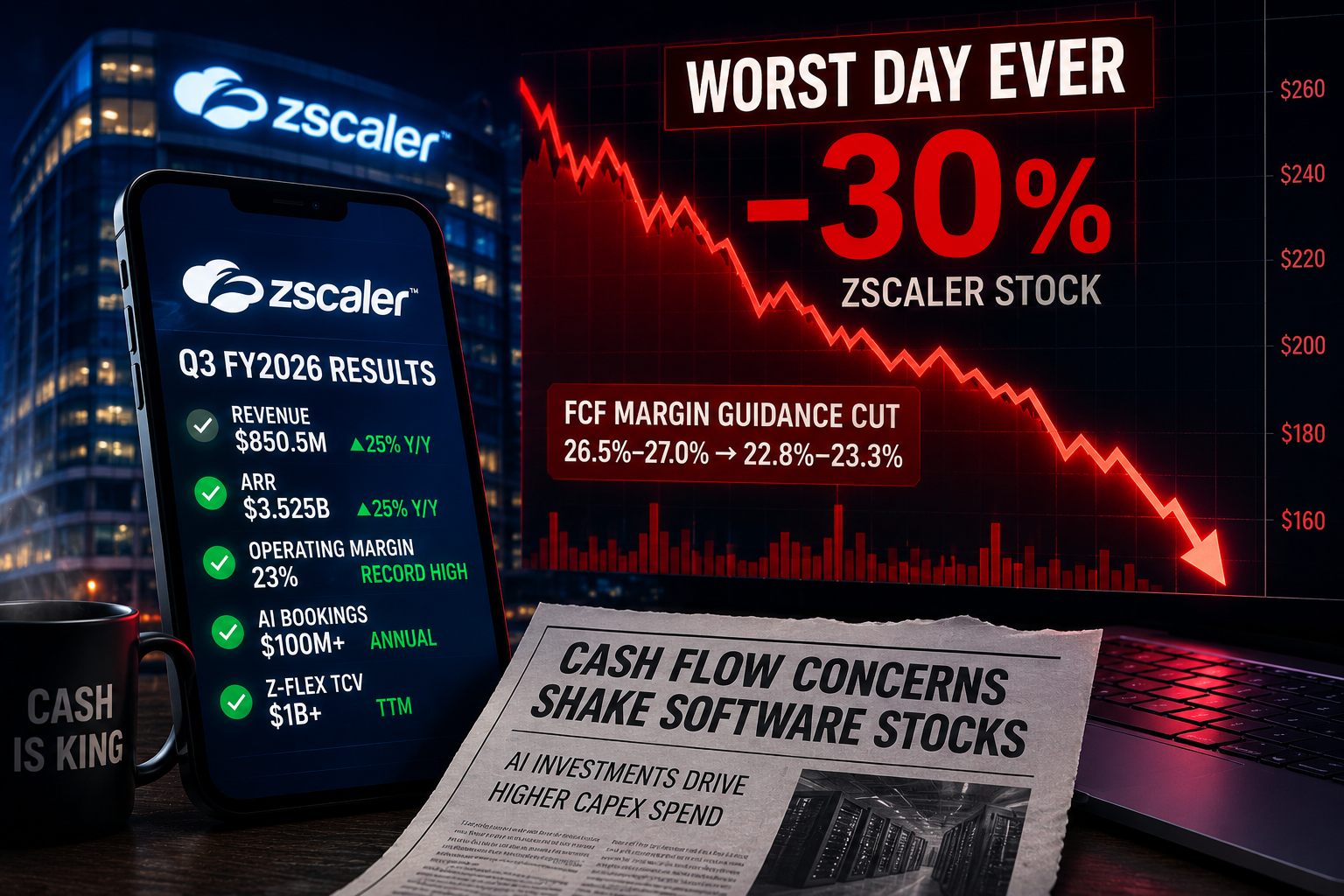
On Tuesday night, Zscaler reported one of the strongest quarters in its history. Revenue grew 25% year-over-year to $850.5 million. Operating margins hit a record high. The company’s AI security offerings crossed $100 million in annual bookings. By almost any conventional measure, it was a beat.
By Wednesday morning, the stock was down nearly 30%.
That single fact tells you more about where the software market is right now than almost any analyst report could. Zscaler’s earnings weren’t the story. The guidance was — and specifically, one line about free cash flow margins. What followed was the company’s worst single-day stock drop on record, a premarket plunge of roughly 24% that extended further as the session wore on.
If you want to understand what’s happening to software stocks in 2026, the Zscaler earnings reaction is the clearest case study available.
What the Numbers Actually Showed
Let’s start with what Zscaler actually reported for Q3 fiscal year 2026 (the quarter ended April 30), because burying the results underneath the reaction would be doing the company a disservice.
Revenue came in at $850.5 million, up 25% year-over-year — solid and consistent with the growth trajectory Zscaler has maintained for years. Annual Recurring Revenue (ARR) grew at the same 25% clip, reaching $3.525 billion. The company guided full-year FY2026 revenue to approximately $3.33 billion, implying roughly 24.6–24.7% annual growth.
The operating side of the house looked even better. Zscaler posted a non-GAAP operating margin of 23% — an all-time high. For a company still growing at this pace, hitting a record margin is the kind of result that, in a different era, would have sent the stock up double digits.
On the AI front specifically, the company’s Z-Flex offering — a flexible consumption model aimed at enterprise AI adoption — crossed $1 billion in total contract value over the trailing twelve months. AI Protect, its product designed to secure AI applications and data pipelines, has now generated more than $100 million in annual bookings. These aren’t vague AI promises. They are real revenue.
The Number That Broke the Stock
So why did a 25%-growth company with record margins and $1 billion in AI bookings lose nearly a third of its value in a single session?
One line in the guidance: free cash flow margin.
Zscaler told investors it now expects full-year free cash flow margin of approximately 22.8% to 23.3% — down from its prior guidance of 26.5% to 27.0%. That’s roughly a 400 basis point reduction. The reason? Capital expenditures. The company is spending heavily on AI-related infrastructure, with capex running in the high single digits as a percentage of revenue, with CFO Kevin Rubin flagging a further increase of up to 200 basis points in fiscal 2027 as equipment prices stay elevated.
To translate: Zscaler is pouring money into the same AI infrastructure that it’s also building products on top of. That costs cash. And in 2026, cash flow is the new earnings.
For years, software investors were willing to accept minimal or negative free cash flow in exchange for revenue growth. That era is largely over. After the rate shock of 2022–2023 recalibrated how markets value long-duration assets, free cash flow generation became the primary lens through which institutional investors evaluate software businesses. When Zscaler cut its FCF outlook by roughly 400 basis points, it wasn’t just revising a financial metric — it was signaling that the margin expansion story, which had been the bull thesis, was getting pushed out.
There was a secondary factor that didn’t help: the company confirmed the departure of two sales leaders during the quarter. CFO Rubin characterized the guidance as reflecting a “prudent approach” given the leadership transitions. That kind of language, in that context, tends to read as an invitation to reduce exposure until the next quarter proves otherwise.
The Bigger Pattern: AI Is Punishing Software Stocks Even When They Win
Zscaler isn’t alone. This is part of something larger happening across the enterprise software sector in 2026.
Consider Salesforce, which reported its own results Wednesday evening. The company beat non-GAAP EPS by a staggering 24% — $3.88 per share against the $3.13 consensus. Its Agentforce AI platform has now generated $1.2 billion in bookings. Revenue grew 13% year-over-year to $11.1 billion. Salesforce is executing.
The stock briefly fell 3% in after-hours trading, and at this point, CRM is already down 33% for the year despite having beaten estimates in virtually every quarter. The market has decided, for now, that the risk of AI disrupting Salesforce’s core business outweighs the evidence that Salesforce is adapting to AI.
This is the dynamic that’s defining software investing in 2026: the market is simultaneously pricing in (a) the risk that LLMs will commoditize or replace point-solution software products, and (b) the cost of building the AI infrastructure required to stay relevant. That’s a double tax on cash flow that didn’t exist in the prior cycle — and it’s compressing valuations even for companies that are clearly executing.
It’s not irrational. The uncertainty is real. When a single large language model can replicate the function of a focused software application, the long-term addressable market for that application legitimately shrinks. Investors aren’t wrong to ask the question. But the severity of the punishment — a 30% single-day drop on a 25%-growth business — suggests the market is currently pricing in the worst-case scenario as the base case.
The Leadership Angle Nobody Is Talking About Enough
One thing that deserves more attention than it’s getting: Zscaler lost two sales leaders in the same quarter. In cybersecurity — and especially in enterprise security where relationships and trust are everything — senior sales leadership continuity matters enormously.
Enterprise security deals are long-cycle, relationship-driven sales. The people closing $10–50 million contracts with Fortune 500 security teams don’t just carry a quota. They carry institutional relationships built over years. When two of those leaders leave in the same quarter, the near-term pipeline math gets complicated in ways that don’t always show up immediately in ARR or revenue numbers. They show up three to six quarters later.
That’s a risk worth monitoring, and it explains why CFO Rubin framed the guidance conservatively. It wasn’t just about capex.
What This Means for Investors Watching Software Stocks
If you’re a retail investor with exposure to enterprise software — whether through individual names or through ETFs that hold positions in ZS, CRM, or their peers — here are three things worth keeping in mind as you process what’s happening.
Free cash flow margin is the number to watch, not EPS. In a high-rate, AI-capex environment, earnings per share can look fine while the underlying cash generation is deteriorating. Get in the habit of reading the FCF guidance alongside the EPS beat. That’s where the real story is.
A stock going down doesn’t mean the business is failing. Zscaler grew 25% and hit record operating margins. The selloff is a valuation reset driven by guidance and sector sentiment — not evidence that the company is broken. Understanding the difference between a business problem and a valuation problem is one of the most important distinctions in investing.
The AI disruption trade is real, but it may be overcorrecting. Companies like Zscaler that are actively building AI-native products — with $100M+ in AI bookings to show for it — are not the passive victims of AI disruption. They are participants in it. The market’s current tendency to punish any AI-related capex spend as a signal of weakness may be creating pricing inefficiencies that eventually correct. It may also be correctly sniffing out a structural headwind. Nobody knows for certain, which is why position sizing matters more than thesis confidence in a market like this one.
The software sector will find its floor. It always does. But the repricing isn’t over, and today’s Zscaler reaction is a reminder that in 2026, you can do almost everything right and still spend the morning explaining to your shareholders why the stock is down 30%.
Sources: Zscaler Q3 FY2026 Earnings Call Transcript (Motley Fool / Globe and Mail); CNBC earnings coverage; Benzinga; FX Leaders; GuruFocus. Data points reflect figures reported by Zscaler on May 27, 2026.