
While most of crypto’s attention this week has been fixed on Bitcoin sliding toward $75,000 and whether the broader market can find a floor, a quieter story has been unfolding on the XRP Ledger — one that has almost nothing to do with price and almost everything to do with the kind of institutional infrastructure that serious money cares about.
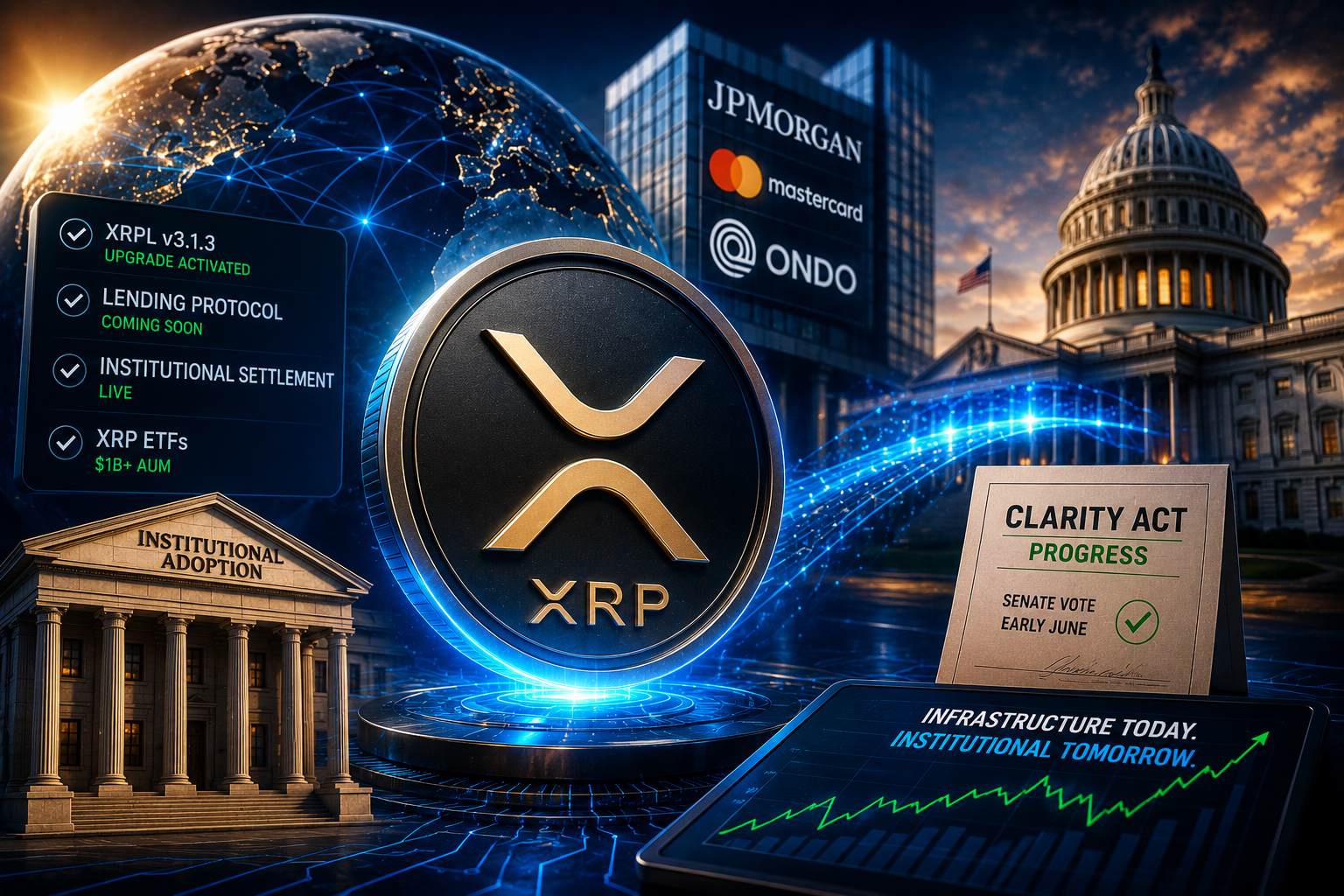
Today, May 27, is a deadline. XRPL node operators were required to upgrade their software to version 3.1.3 or face being amendment-blocked — a technical term that means the network stops sharing ledger validation, transaction data, and governance participation with nodes that didn’t comply. Former Ripple CTO David Schwartz confirmed the cutoff publicly. The FixCleanup3_1_3 amendment, which delivers critical bug fixes for NFTs, Vaults, and lending protocols, is now active. Nodes that ignored the upgrade are, effectively, locked out.
That is exactly how a professional-grade financial rail is supposed to work. And that’s the story that tends to get lost in the noise about price.
What Happened on the XRP Ledger This Month
The node upgrade is not an isolated event. It’s one milestone in a sequence of technical and institutional developments that have been accelerating across the XRPL ecosystem throughout May 2026.
Start with the lending protocol. Ripple teased XRPL v3.2.0 on May 23, a foundational upgrade that introduces native on-chain lending through Single Asset Vaults. In plain terms: the XRP Ledger will support fixed-term, uncollateralized loans directly on-chain, without a third-party intermediary. That is not a retail crypto feature. That is the infrastructure requirement for institutional DeFi — the kind of capital deployment that hedge funds, asset managers, and treasury desks need before they can put real money to work on a blockchain network.
Then there’s the institutional settlement that happened in production — not in a press release, not in a pilot, but in a live transaction. JPMorgan, Mastercard, and Ondo Finance settled a cross-border tokenized Treasury transaction on the XRP Ledger in real time. Tokenized U.S. Treasuries, settled across jurisdictions, on a public ledger, in real time. A year ago that sentence would have read like speculation. Today it’s a fact.
And layered underneath all of it: seven XRP spot ETFs are now trading in the United States, with combined assets under management of $1 billion and 904.8 million XRP tokens locked across those products. That’s institutional demand expressed not in social media posts but in custodied assets.
The Paradox That Serious Investors Are Watching
Here’s what makes the XRPL story genuinely interesting — and genuinely unusual — right now: the price of XRP is down approximately 26% year-to-date, sitting around $1.37 at the time of writing. In a market where price is often treated as the only scoreboard, that number looks bad.
But consider what’s happened during that same drawdown period. A $1 billion ETF structure was built and deployed. JPMorgan and Mastercard executed a live tokenized settlement on the ledger. Fifteen additional HBAR ETF filings hit the SEC (a related ISO 20022 network moving in parallel). The XRPL’s native lending protocol was announced. And today, a mandatory infrastructure upgrade was enforced network-wide with zero tolerance for stragglers.
None of that is the behavior of a network losing relevance. It’s the behavior of a network being built out for institutional use — which historically precedes retail price discovery, not the other way around.
The divergence between adoption metrics and price is the most important thing to understand about where XRP sits right now. Institutional investors accumulating through ETFs, settling real transactions on-chain, and filing regulatory paperwork don’t typically move markets immediately. They move markets when the regulatory and structural conditions catch up to the infrastructure that’s already been built.
Why the CLARITY Act Is the Missing Piece
That regulatory catch-up has a name and, potentially, a date.
The Digital Asset Market Clarity Act — commonly called the CLARITY Act — cleared the Senate Banking Committee on May 14 in a 15-9 vote, with bipartisan support. It now heads to the full Senate floor, where a vote is expected in early June. The White House has set a target of signing the bill by July 4.
What the CLARITY Act would do, at its core, is resolve the years-long ambiguity over whether digital assets fall under SEC or CFTC jurisdiction. For XRP specifically — which spent years fighting an SEC enforcement action before settling — this matters enormously. Clear regulatory classification is the final condition that large institutions have been waiting for before committing capital at scale. Asset managers don’t build billion-dollar product lines on ambiguous legal ground.
The bill still faces obstacles. It needs 60 votes in the Senate to overcome a filibuster, which means seven Democratic votes are the deciding factor. Opposition from banking industry groups (concerned about stablecoin provisions eroding deposit bases) and some Democratic members creates real uncertainty about the July 4 timeline. But the direction of travel is clear, and the CLARITY Act is closer to becoming law right now than at any point in the history of U.S. crypto legislation.
If it passes, the infrastructure already built on the XRP Ledger — the ETFs, the lending protocol, the institutional settlement rails — has a regulatory framework to operate within. That’s the unlock the market has been waiting for.
The Broader ISO 20022 Picture
XRP is not operating in isolation. The broader ISO 20022-compliant ecosystem — which includes Stellar (XLM), Hedera (HBAR), Algorand (ALGO), and Quant (QNT) alongside XRP — has been generating its own institutional momentum.
Quant (QNT) jumped nearly 9% on May 22 as capital flowed into infrastructure tokens amid growing attention on the UK’s Government Blockchain Tokenized Deposit (GBTD) project, where Quant’s Overledger protocol serves as the core interoperability layer. That project is expected to complete around mid-2026, and it represents the kind of government-level use case that validates the ISO 20022 interoperability thesis.
Stellar (XLM) hit a total value locked of $190 million in May, near its all-time high of $206 million set in April, and signed a new blockchain partnership with the Bermuda government earlier this month. T. Rowe Price included XLM in an active crypto ETF filing — another signal of institutional interest moving from concept to product.
Hedera (HBAR) continues to build enterprise adoption through its governing council — Google, Chainlink, Fireblocks, Moody’s, Accenture, FedEx, and McLaren are all members — while 15 HBAR ETF applications are currently under SEC review, including filings from Grayscale and Bitwise. Georgia’s Ministry of Justice is in the process of migrating its national real estate registry to Hedera’s network.
These aren’t small projects. They’re national registries, sovereign government pilots, and trillion-dollar asset managers. The ISO 20022 payment rail story is being built network by network, and the pieces are falling into place faster than the price charts suggest.
The Bottom Line
The XRP Ledger enforced a mandatory infrastructure upgrade today. JPMorgan and Mastercard have already settled a live tokenized transaction on it. A billion dollars in ETF assets sits on top of it. Native lending is coming to it in version 3.2.0. And the legislation that would unlock the full institutional capital stack is closer to the finish line than it’s ever been.
Whether you track XRP by its price or by its infrastructure buildout, you’re looking at the same asset through two very different lenses. Right now, the infrastructure lens is telling a more complete story.
The regulatory and pricing catch-up, if and when it comes, tends to happen fast. That’s when the audience that wasn’t watching usually shows up.
For more on the ISO 20022 payment rail ecosystem, including weekly roundups on XRP, XLM, HBAR, ALGO, and QNT, subscribe to Ledger Prime News. This article is for informational purposes only and does not constitute financial or investment advice.
Sources:
- XRPL Nodes Must Upgrade by May 27 — CCN
- Institutional DeFi on XRPL — Ripple Insights
- XRPL Lending Protocol Expansion — BeInCrypto
- XRP ETF Tracker — XRP-Insights
- CLARITY Act Clears Senate Committee — CNBC
- CLARITY Act Timeline to July 4 — CryptoTimes
- CLARITY Act Yield-as-a-Service — CoinDesk
- QNT UK Tokenized Deposit Project — CoinMarketCap AI
- XLM Latest Updates — CoinMarketCap AI
- HBAR Institutional Infrastructure 2026 — AInvest