
The most consequential financial news of the weekend didn’t come from an earnings report or an economic data release. It came from a Truth Social post.
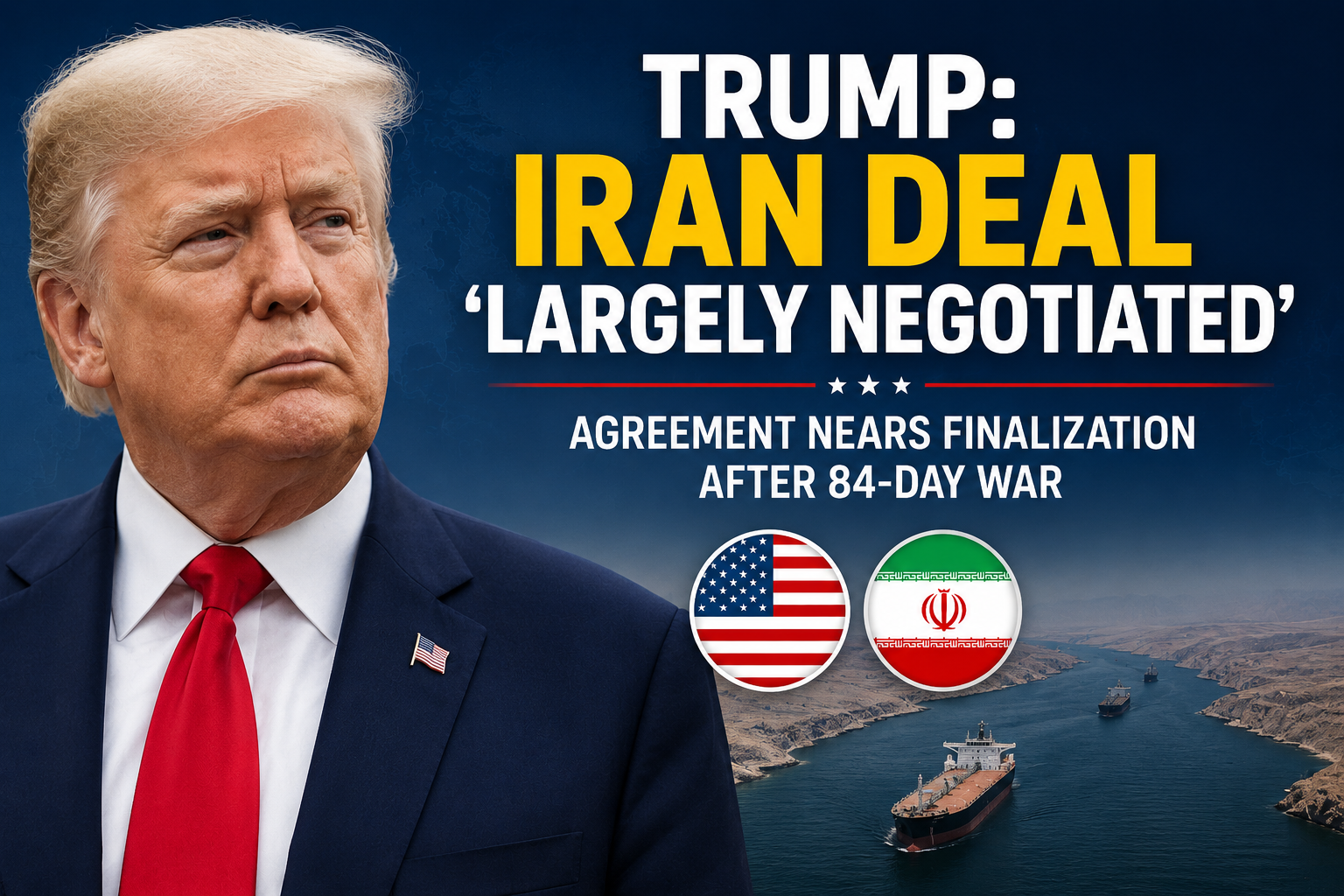
President Trump announced Saturday that an agreement with Iran has been “largely negotiated,” following a conference call with leaders from Saudi Arabia, the UAE, Qatar, Pakistan, Türkiye, Egypt, Jordan, and Bahrain. Final details are still being worked out, but the message was clear: the 84-day war with Iran is nearing an end.
“An Agreement has been largely negotiated, subject to finalization between the United States of America, the Islamic Republic of Iran, and the various other Countries, as listed,” Trump wrote. He added that a separate call with Israeli Prime Minister Netanyahu “likewise went very well,” and that final details “will be announced shortly.”
If this deal closes — and it’s a meaningful “if” — the financial market implications are significant and immediate. Here’s what you need to understand before markets open Monday.
The Strait of Hormuz Is the Number That Matters
Trump specifically flagged the opening of the Strait of Hormuz as a key provision of the deal, and that single detail is the most important thing in this entire announcement for anyone watching energy markets.
The Strait of Hormuz is the narrow waterway between Iran and Oman through which roughly 20% of the world’s oil supply transits. U.S. Central Command has spent weeks redirecting 100 commercial vessels during a maritime blockade of Iranian ports. Tanker traffic through the strait has been severely disrupted. That disruption — not some abstract geopolitical risk premium — is a primary driver of crude oil trading above $100 a barrel this week, and of regular gasoline sitting at $4.56 per gallon nationally, the highest since 2022.
If the Strait reopens with guaranteed free passage (Secretary of State Rubio had previously set that as a non-negotiable condition alongside Iran surrendering its enriched uranium), the supply shock that’s been running for months begins to unwind. Oil markets price in future supply, not just current supply. A credible deal announcement could send crude materially lower in Monday’s pre-market before the ink is even dry.
What Lower Oil Does to Everything Else
Walk through the cascade effect:
Inflation. April’s CPI came in at 3.8% year-over-year — the highest since May 2023 — with energy costs and energy-derived transportation costs (airfares up 20.7%, transit up 5.6%) doing significant damage. If crude falls from the $98–100 range back toward the $70s or low $80s, those categories reverse. A meaningful oil price decline through June would show up in the May and June CPI prints, giving the Federal Reserve genuine cover to consider rate cuts rather than facing pressure to hike.
The Fed. Kevin Warsh was sworn in as Fed Chair this morning — his first day on the job — with a complicated hand to play. His AI-productivity thesis for rate cuts looked strained against a 3.8% CPI and $100 crude. A deal that sends oil lower hands him a credible economic rationale for moving toward rate cuts without looking like he’s bowing to White House pressure. That’s a very different opening week than he walked into this morning.
Consumer spending. Americans collectively spent an estimated $3.5 billion in extra gas costs this Memorial Day weekend alone versus year-ago prices. Every $0.50 drop in average national gas prices puts roughly $75–80 per month back in the pocket of the average American household that drives. That’s real consumer relief, and it shows up in retail sales, restaurant spending, and confidence surveys within a few months.
Equities. Rate-sensitive sectors that have been beaten down by the 10-year Treasury yield’s climb to 4.59% — homebuilders, utilities, REITs, high-growth tech — are the obvious beneficiaries of a scenario where oil falls, inflation cools, and the rate path shifts dovish. Airlines and cruise lines, which got hammered by fuel costs, stand to recover quickly. Consumer discretionary broadly benefits when gas prices fall.
A Word of Caution: “Largely Negotiated” Is Not “Done”
It’s worth reading Trump’s language carefully, because he chose his words deliberately. The deal is “largely negotiated, subject to finalization.” Earlier the same day, he told Axios he was “solid 50/50” on whether he’d sign a deal or “blow them to kingdom come.” Those are not the words of someone announcing a signed agreement.
Final details are still being discussed. Iran’s willingness to surrender enriched uranium — a core U.S. demand that Iran’s supreme leader appeared to resist as recently as Thursday — is still listed as a requirement. Diplomatic agreements of this complexity have collapsed before at the final-details stage. A regional diplomat told Fox News the discussions were “very positive,” but “very positive” and “signed” are different things.
Markets will price in a probability, not a certainty. The question Monday morning is how much of this rally gets priced in at open and whether a subsequent breakdown in talks would trigger a reversal. Traders who chase a gap-up open in energy-sensitive names on Monday without accounting for execution risk are taking on asymmetric downside.
What This Means for Crypto
The connection is less direct but real. Bitcoin has been unable to break above its 200-day moving average near $82,000 — a level that also represents the average cost basis for investors in Bitcoin ETPs. The barrier is partly technical and partly psychological: months of a macro bear market, high inflation, and rising yields made crypto unattractive versus cash yielding real returns.
A scenario where oil falls, CPI cools, the Fed moves toward cuts, and the 10-year Treasury yield comes off its 4.59% peak is structurally positive for risk assets, which includes crypto. It doesn’t guarantee a BTC breakout — the bear market psychology Schwab’s crypto research team described this week takes time to heal regardless of macro conditions — but it removes one of the most significant headwinds.
For ISO 20022 tokens like XRP, HBAR, and XLM, which are positioned as infrastructure for institutional cross-border payments, a de-escalating geopolitical environment also eases the broader financial system uncertainty that tends to slow institutional adoption timelines.
The Bottom Line
Trump’s announcement is the biggest macro development of the weekend, and potentially one of the most significant of the year if the deal finalizes. The direct chain of causation — open Strait → more oil supply → lower crude prices → cooling inflation → Fed rate cuts → risk asset rally — is clear. The execution risk is also real.
Watch the overnight Sunday futures market for the first signal of how aggressively traders are pricing the deal. Watch Monday’s oil open as the most direct read. And watch for any follow-up statement from either the U.S. or Iranian side over the weekend that confirms, complicates, or collapses what Trump announced this morning.
This story is still developing. We’ll have updates as the situation clarifies.