
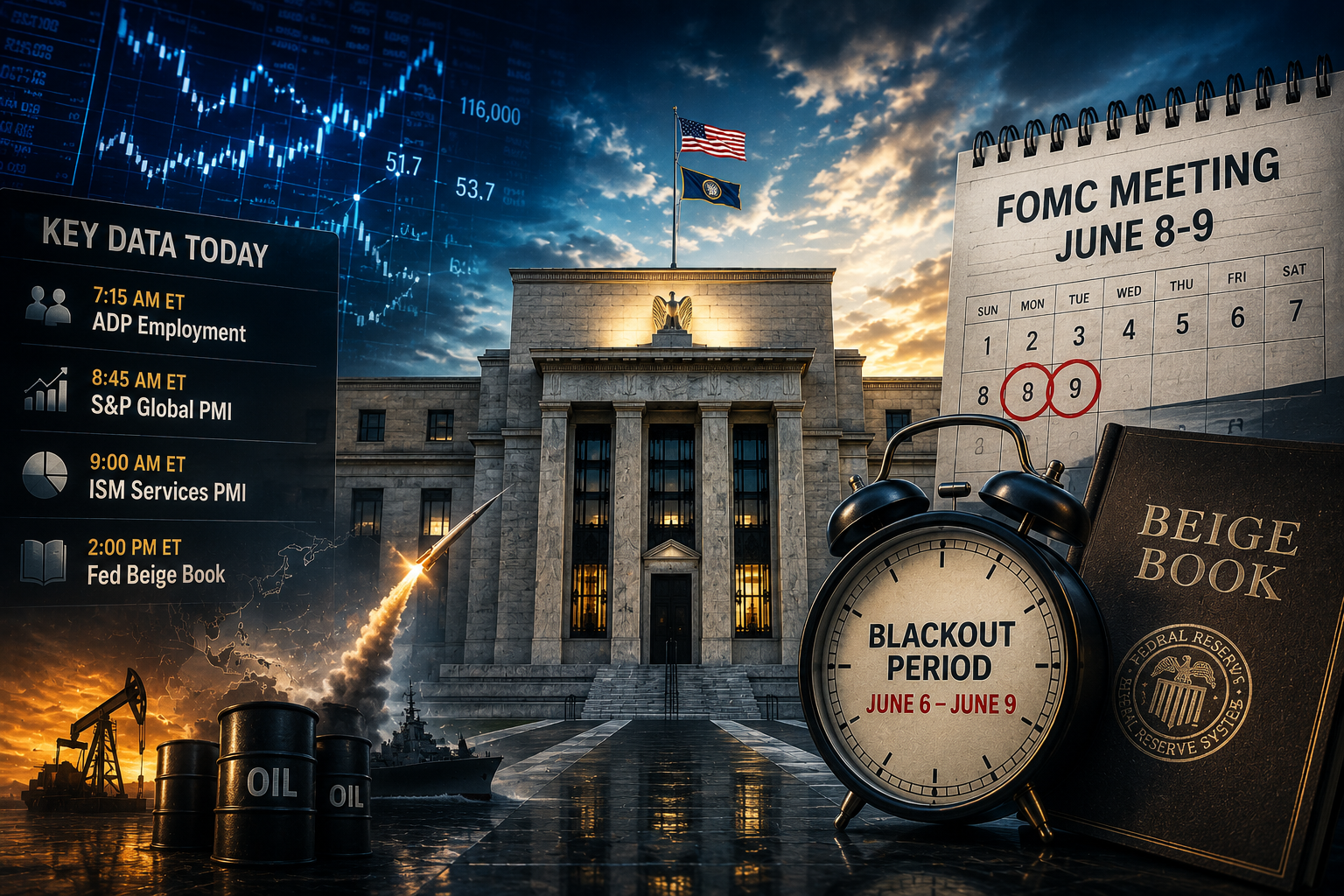
The Federal Reserve goes quiet on Saturday.
Starting June 6, every Fed governor and regional bank president enters the pre-meeting blackout period — no speeches, no interviews, no public commentary — ahead of the June 8–9 FOMC meeting. That meeting, importantly, is not a routine one. It comes with a full Summary of Economic Projections, meaning markets will get an updated dot plot showing where policymakers think interest rates are headed through the rest of 2026 and into 2027.
That makes today — Wednesday, June 3 — the last day that matters before the silence falls.
Three major economic reports land before noon. The Fed’s own Beige Book follows in the afternoon. By the time markets close today, policymakers will have absorbed the final picture they’re taking into next week’s meeting. So will you, if you’re paying attention.
Here’s what to watch.
The Morning Sequence
7:15 AM ET — ADP Nonfarm Employment (forecast: +116,000)
The ADP report has a complicated reputation. It often diverges from the official government payrolls number released on Fridays, which means professional economists treat it with skepticism. But it’s still the first employment-related data of the week, and in a market that’s increasingly sensitive to any sign that the labor market is cooling, a significant miss in either direction will move things.
The previous reading came in at 109,000. Consensus expects a modest uptick to 116,000. That’s not a strong number by historical standards — for context, monthly private payroll gains were routinely running at 200,000+ in the post-pandemic expansion — but it fits the “soft landing in progress” narrative the Fed has been threading for the past year.
A number well above 150,000 would likely push rate-cut expectations further out. A number below 90,000 would reignite recession-watch sentiment and could put a June cut back on the table, even though most analysts currently assign that outcome low probability.
8:45 AM ET — S&P Global Composite PMI (forecast: 51.7)
This is the preliminary read on combined manufacturing and services activity. At 51.7, consensus expects the economy to hold exactly where it was last month — technically expansionary (anything above 50), but not accelerating. Think of this as the “steady state” signal. If it confirms, it adds nothing new; if it surprises sharply in either direction, it reframes the morning conversation before the bigger ISM number arrives fifteen minutes later.
9:00 AM ET — ISM Non-Manufacturing PMI (forecast: 53.7)
This is the one that matters most of the three morning releases. The services sector is the engine of the U.S. economy — roughly 70% of GDP — and the ISM’s read on it carries significant weight with Fed officials. Consensus is 53.7, essentially flat from April’s 53.6. That reading would be consistent with an economy that’s slowing from its 2023–2024 peak but hasn’t broken down.
Watch the employment sub-index within the ISM report. If services businesses are still actively hiring, that’s upward pressure on wages, which feeds into services inflation — the one component of the inflation picture the Fed has had the hardest time taming.
The Context Nobody’s Talking About Enough: Oil and Geopolitics
Before you look at today’s data in isolation, you need to understand the backdrop it’s landing into.
Overnight, U.S. Central Command confirmed that American forces intercepted Iranian ballistic missiles and drones and conducted “self-defense strikes” on Iran’s Qeshm Island. This follows Operation Epic Fury — the joint U.S.-Israel military campaign against Iran that ran from late February through May 5. Markets thought that chapter was closed. Apparently it isn’t.
Why does this matter for rate decisions? Because energy prices don’t respond to dot plots.
Oil has already been elevated since the Strait of Hormuz disruptions earlier in the year — through which roughly 20% of the world’s oil supply transits. A sustained re-escalation would push energy costs higher again, directly feeding headline CPI and PPI prints. The Fed can look past a single month of energy-driven inflation. It has a much harder time ignoring a structural supply disruption that keeps oil prices stubbornly elevated quarter after quarter.
This is the variable that complicates what would otherwise be a straightforward “data confirms soft landing, Fed stays on course” narrative. Policymakers walking into the June 8–9 meeting are doing so with a geopolitical wildcard they can’t model.
The 2:00 PM ET Wildcard: The Beige Book
At roughly 2:00 PM ET, the Federal Reserve publishes the Beige Book — a qualitative, district-by-district assessment of economic conditions compiled by all twelve regional Fed banks. It doesn’t move markets the way a jobs number does, and it doesn’t show up in financial media the same way either. Most retail investors don’t read it.
That’s a mistake.
The Beige Book is how you get the texture of the economy that the hard data misses. Are restaurant owners in the St. Louis district struggling to fill positions? Are retailers in the Dallas district seeing customers pull back on discretionary spending? Are commercial real estate lenders in the New York district tightening standards? The Beige Book surfaces that ground-level reality two weeks before the FOMC meeting — and Fed officials read it carefully.
Given the geopolitical backdrop and the recent inflation stickiness in services, watch specifically for language around:
- Wage pressure in services industries
- Consumer spending trends (any early signs of pullback?)
- Energy cost pass-through — are businesses in energy-intensive sectors raising prices?
What the Fed Is Actually Deciding
Let’s be direct about what all of this data feeds into.
Coming into the June meeting, the market-implied probability of a rate cut at this meeting is low. Fed funds futures have priced in a “hold” as the base case for June, with the market expecting the first cut to come later in the summer or fall — contingent on further evidence that services inflation is cooling and the labor market is normalizing.
The June dot plot is where this gets interesting. In March, the median projection pointed to two cuts in 2026. Between then and now, oil prices have risen, the Iran conflict injected new inflationary risk, and the labor market has remained more resilient than expected. There is a real possibility that when the new dots land on June 9, the median moves from two cuts to one — or that the range of views widens substantially, signaling internal disagreement.
That’s the storyline today’s data is feeding. Not “will they cut in June?” (almost certainly not). But “what does the dot plot look like, and how does the Fed characterize the balance of risks?”
If ADP and ISM both come in at or above consensus, and the Beige Book paints a picture of modest but steady growth, the Fed has cover to hold rates and mark down the number of projected 2026 cuts. If data disappoints across the board, the pressure for an earlier cut grows — and the dot plot could surprise to the dovish side.
The Earnings Wild Card
One more thing worth noting as you watch today’s macro data: Broadcom (AVGO) and CrowdStrike (CRWD) both report after the close tonight.
Broadcom is consensus at $2.40 EPS and $22.11 billion in revenue, with AI semiconductor revenue expected somewhere between $4.1 and $5 billion for the quarter. CrowdStrike is consensus at $0.88 EPS on roughly $1.36 billion in revenue, with the cybersecurity firm’s net new annual recurring revenue (ARR) being the number that will drive after-hours trading.
These aren’t directly macro. But two of the largest AI-infrastructure and cybersecurity names reporting on the same evening as a loaded data calendar means after-hours price action tonight will set the tone for Thursday’s open. Watch both prints closely.
The Bottom Line
By 9:30 AM today, you’ll have a clear picture of whether the U.S. economy is tracking the “moderate slowdown, inflation cooling” path the Fed wants — or whether it’s sending mixed signals into a meeting that already has a complicated geopolitical overlay.
The blackout starts Saturday. Whatever the data shows today is what goes into next week’s decision. Pay attention.