
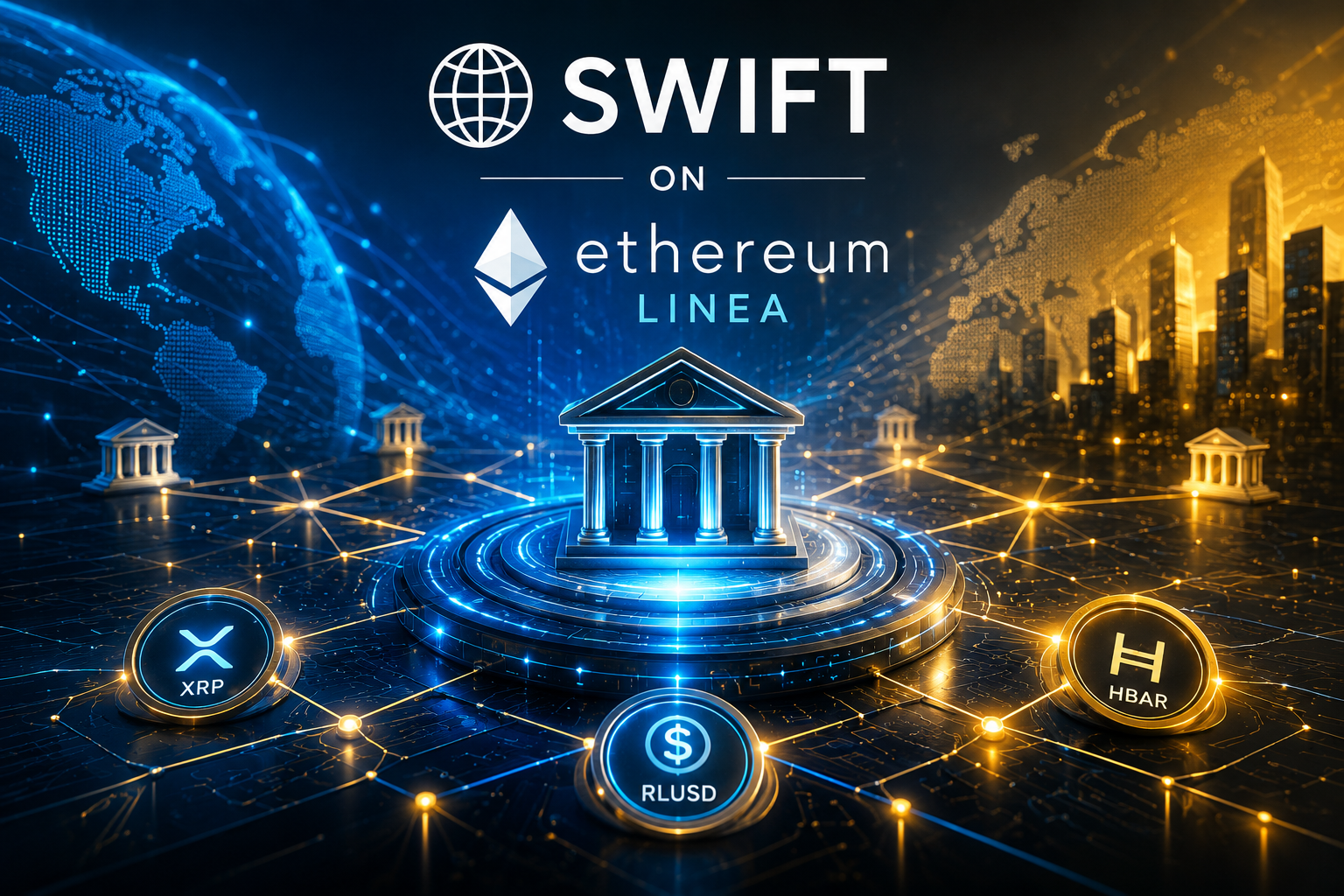
If you’ve been following the ISO 20022 conversation in crypto — and if you’re reading this, you probably have — you’ve likely seen years of speculation about which token SWIFT would eventually choose as the backbone of its blockchain settlement infrastructure. XRP was the perennial frontrunner in those discussions. HBAR was the dark horse. The story was always framed as a competition.
The answer turned out to be neither. SWIFT chose Linea — an Ethereum Layer 2 built by ConsenSys — for its blockchain-based shared ledger pilot. Over 30 of the world’s largest banks, including JPMorgan, HSBC, and BNP Paribas, are participating. The MVP is targeted to go live with real-world transactions in 2026.
Before you decide what this means for your XRP or HBAR position, let’s actually understand what happened and why.
First, What SWIFT Built — and What It Didn’t
To understand the choice, you need to understand the problem SWIFT was solving.
When ISO 20022 officially went live on November 22, 2025 — the date SWIFT retired its legacy MT messaging format after 97% of payment instructions had already migrated — it standardized how payment instructions are communicated between banks. Rich structured data, machine-readable formats, full party identification. The messaging problem was solved.
But ISO 20022 doesn’t move money. It moves instructions. The settlement infrastructure — the actual layer where value changes hands — remained a separate challenge. Banks still rely on correspondent banking chains, bilateral nostro/vostro accounts, and end-of-day batch settlement for most cross-border payments. That’s the friction SWIFT is now trying to remove with blockchain.
The shared ledger it built on Linea is a permissioned infrastructure layer: a private, bank-controlled network where tokenized deposits, regulated stablecoins, and central bank digital currencies can move between institutions in real time, around the clock. The key technical choice behind selecting Linea specifically was zero-knowledge rollups — a cryptographic technique that allows transactions to be validated and settled privately without exposing sensitive data on a public chain. Ethereum Mainnet alone couldn’t do this at the volumes and privacy requirements that institutional finance demands. Linea, as a ZK rollup Layer 2, can.
The result is a system that inherits Ethereum’s security and smart contract programmability while operating at the speed, cost, and confidentiality that banks actually need.
Why Not XRP? Why Not HBAR?
SWIFT did test both. That’s not speculation — it’s documented. SWIFT ran trials on Ripple’s XRP Ledger and Hedera’s Hashgraph for cross-border payment optimization and interoperability. Those tests were real, and they confirmed that both networks can handle the technical requirements of fast, efficient cross-border settlement.
But SWIFT didn’t choose a token. It chose infrastructure. And that distinction is everything.
The shared ledger is explicitly designed to be token-agnostic. It supports whatever regulated asset banks bring to it — tokenized bank deposits, regulated stablecoins like RLUSD, CBDCs. The ledger records, sequences, and validates transactions. It doesn’t mandate what the unit of value is.
XRP and HBAR are tokens. SWIFT’s system is rails. The question was never really “which token will SWIFT pick?” — it was “what infrastructure will SWIFT build?” and “what can plug into that infrastructure?” Those are different questions with different answers.
SWIFT chose Linea because ZK rollup privacy, permissioned access, and Ethereum’s institutional familiarity gave it the properties it needed for the settlement layer. The token question was left deliberately open.
So Is the XRP/HBAR Thesis Dead?
No — but it needs to be restated more precisely.
The version of the thesis that said “SWIFT will choose XRP as its settlement token” was always somewhat overblown in crypto communities, and it never had official SWIFT confirmation. That version of the thesis is now clearly incorrect.
The version that still holds: XRP, HBAR, XLM, and other ISO 20022-compliant tokens are positioned as settlement assets within a world of standardized financial messaging, not as the exclusive infrastructure layer of any single network. That world exists and is growing regardless of what SWIFT specifically built.
Ripple has over 300 banks integrated into RippleNet independently of SWIFT. Its On-Demand Liquidity product uses XRP as a bridge asset for cross-border payments between currency pairs that don’t have deep correspondent banking relationships. That use case doesn’t require SWIFT’s blessing — it requires payment corridors where XRP’s sub-4-second settlement and minimal fees offer a genuine cost advantage over the existing system. Those corridors exist today and are expanding.
Hedera’s thesis was never primarily about SWIFT either. HBAR’s institutional story is built on enterprise tokenization — Georgia’s Ministry of Justice is migrating its national real estate registry to Hedera’s network, 15 ETF filings are under SEC review, and the Wyoming State Stablecoin Project uses Hedera’s Stablecoin Studio infrastructure. None of that changes based on what settlement layer SWIFT chose.
Critically, the token-agnostic design of SWIFT’s shared ledger doesn’t lock XRP or HBAR out. A bank settling a cross-border payment could theoretically use XRP or RLUSD as the intermediate asset on Linea’s infrastructure, in the same way you can use different currencies on the same payment rails. The architecture doesn’t choose the token — the participating institutions do.
What This Actually Changes
The most significant thing SWIFT’s Linea choice changes isn’t the fundamentals of XRP or HBAR. It’s the narrative that’s been running in crypto communities for years.
The “SWIFT will pick XRP” story was compelling because it was simple. A definitive institutional endorsement. A clear winner. The reality is messier: SWIFT built permissioned Ethereum infrastructure with a token-agnostic design, tested multiple networks, and left the asset layer to the market to resolve. That’s a more sophisticated outcome than a single endorsement, but it’s also less clean as a retail investing thesis.
For anyone holding XRP or HBAR based on the SWIFT narrative, the practical question is whether the underlying use cases — payment corridors, tokenization, DeFi infrastructure, CBDC integration — are strong enough to carry the thesis on their own. The data suggests they are. But the “SWIFT chose us” moment that a segment of the community was waiting for isn’t coming in the form anyone expected.
The lesson here isn’t that ISO 20022-compliant tokens are irrelevant to what SWIFT is building. It’s that the relationship is going to be more indirect, more competitive, and more market-driven than the simple narrative suggested. That’s actually the more interesting story — and the more durable one.
Sources: SWIFT Chooses Ethereum Layer-2 Linea — EtherWorld | SWIFT Embraces Blockchain: Why It Chose Linea Over XRP/HBAR — CCN | SWIFT’s Shared Ledger: Token-Agnostic Rival to XRPL and Hedera — CCN | SWIFT Tests XRP and HBAR for Cross-Border Payments — The Paypers | SWIFT Moves to Blockchain Settlement With Live Trials — Yahoo Finance | SWIFT Shared Ledger Progresses to MVP — Swift.com | SWIFT Enters Blockchain — XRP, HBAR, or Linea? — Coinspot