
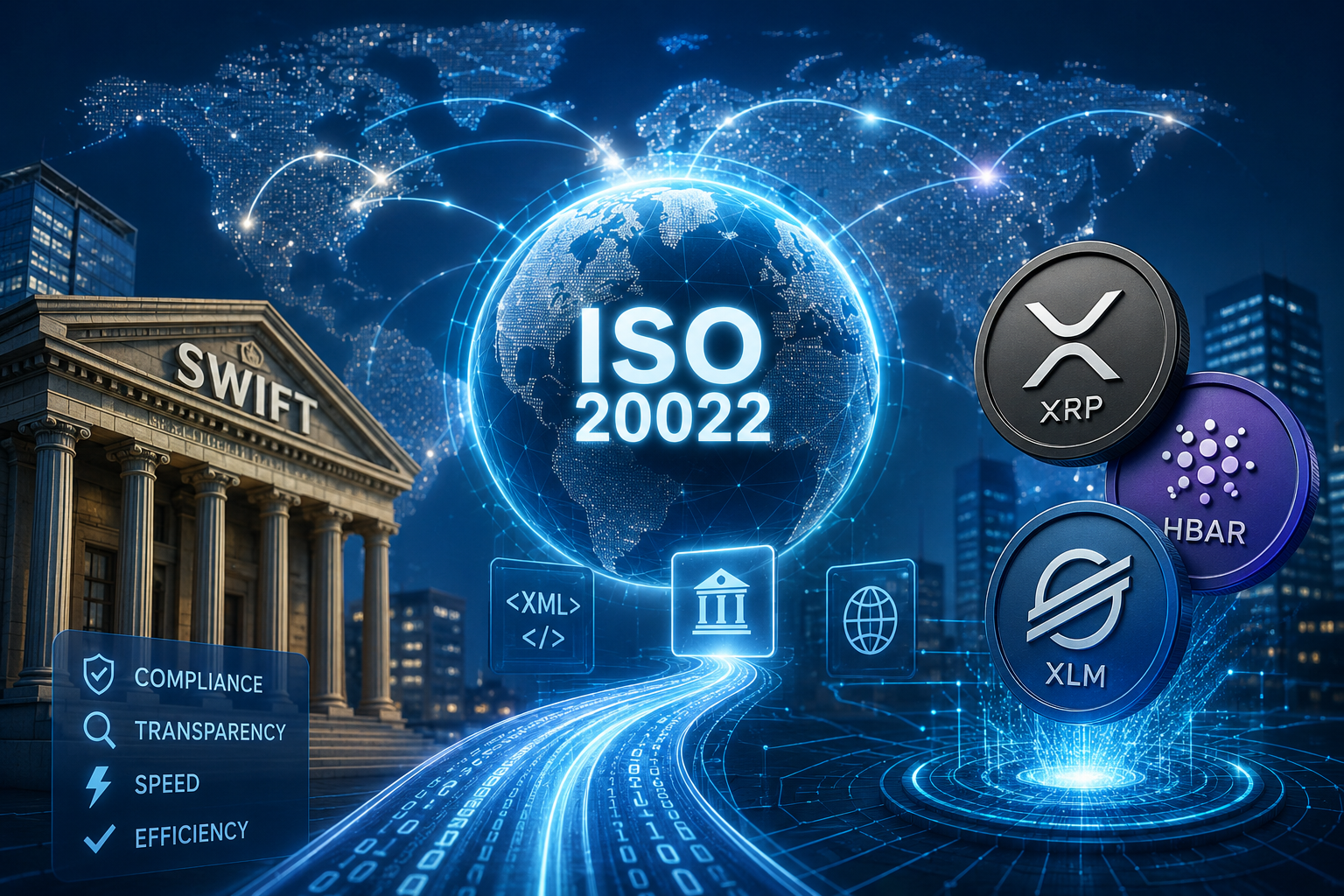
If you’ve been searching for answers on SWIFT’s ISO 20022 migration, you’re not alone — and you’re asking exactly the right question. The shift happening right now in global banking infrastructure is one of the most significant changes to the financial system in decades. It’s also the reason a specific set of cryptocurrencies has been quietly building an institutional following that most retail investors still haven’t fully clocked.
Let’s break it all down.
Is ISO 20022 Replacing SWIFT?
Short answer: no. Longer answer: it’s more interesting than that.
SWIFT — the Society for Worldwide Interbank Financial Telecommunication — is a messaging network. It’s the system that banks around the world use to communicate payment instructions to each other. When your bank sends money internationally, it sends a SWIFT message to the receiving bank saying “pay this person this amount.” SWIFT itself doesn’t move money. It moves the instructions.
ISO 20022 is a standard — a rulebook for the format and content of those financial messages. Think of SWIFT as the postal system, and ISO 20022 as a new regulation requiring everyone to write their addresses in a specific, structured format instead of however they felt like writing it before.
The old format — called MT messaging — has been in use since the 1970s. It was built for a world that no longer exists: limited character sets, unstructured data fields, no ability to carry rich metadata about a transaction. ISO 20022 replaces that with XML and JSON-based messages that can carry detailed remittance data, structured party identifiers, purpose codes, compliance information, and much more.
So SWIFT isn’t being replaced. SWIFT is adopting ISO 20022. The network stays. The language it speaks changes.
What Just Happened: The Migration Timeline
This migration has been in progress for years, but a critical threshold was crossed on November 22, 2025, when SWIFT’s coexistence period ended. Until that date, banks could send payment messages in either the old MT format or the new ISO 20022 MX format. That window is now closed. Over 97% of cross-border payment traffic has moved to ISO 20022, and the legacy format is being retired.
2026 is the year the remaining gaps get closed — with financial consequences for institutions that drag their feet:
- January 2026: SWIFT began levying additional charges on banks still using contingency MT processing or relying on in-flow translation services to convert old-format messages. Stragglers are now paying a penalty.
- November 2026: SWIFT will begin rejecting payment instructions that contain unstructured address data. Every financial institution sending cross-border payments must include fully structured country codes, town names, and identifiers — no exceptions.
- November 14, 2026: All financial institutions must be able to receive Enquiry and Investigation messages in MX format. Case management and payment cancellation messages follow the same deadline.
The migration isn’t an industry discussion anymore. It’s an enforceable infrastructure requirement with hard deadlines and financial penalties attached.
Why This Matters Beyond Banking
ISO 20022 is more than a back-office formatting change. The richer data it carries changes what’s possible in global finance.
Under the old MT format, a cross-border payment message might contain a name, an account number, and a dollar amount — and little else. Compliance teams had to manually chase down additional information. Investigations and disputes were slow and expensive. Correspondent banking chains — where a payment hops through three or four intermediary banks before reaching its destination — were largely opaque.
ISO 20022 messages can carry structured remittance information (what the payment is actually for), full party identification, LEI codes, and compliance flags, all in a machine-readable format. That means faster AML screening, fewer false positives, real-time payment tracking through SWIFT GPI (Global Payments Innovation), and the ability to automate processes that currently require human review.
For the 11,000+ financial institutions on the SWIFT network moving an estimated $5 trillion per day, that efficiency gain is enormous. But it also creates an opening for newer infrastructure to plug in.
Where Crypto Enters the Picture
Here’s where it gets relevant to digital assets — and why tokens like XRP, HBAR, and XLM have been discussed in the same breath as ISO 20022 for years.
Several cryptocurrencies were built from the ground up to be ISO 20022-compliant. That means the messaging format their networks use for transactions is compatible with the same standard that SWIFT is now mandating across global banking. The practical implication: these tokens can theoretically function as a bridge asset or settlement layer within the same payment infrastructure that ISO 20022 is standardizing.
XRP is the most prominent example. Ripple — the company behind XRP — holds membership in the ISO 20022 Standards Body, meaning it has a seat at the table in shaping how message definitions evolve. RippleNet has over 300 financial institutions integrated into its network, including Santander and SEB. XRP’s ledger settles in under 4 seconds with negligible transaction costs. As of this week, XRP is trading around $1.37 — well off the April highs above $2 that were driven by ISO 20022 hype — but the underlying institutional infrastructure continues to build regardless of price.
Hedera (HBAR) is taking a different approach. Rather than focusing purely on payments, Hedera has positioned itself as enterprise-grade distributed ledger infrastructure — tokenization of real-world assets, AI data integrity, and regulated DeFi. There are currently 15 active Hedera ETF filings under SEC review, including applications from Grayscale and Bitwise. Georgia’s Ministry of Justice has announced plans to migrate its national real estate registry to Hedera’s network. HBAR is trading around $0.09, with the Canary HBAR Spot ETF already listed on U.S. markets and holding approximately 549 million HBAR.
Stellar (XLM) rounds out the core ISO 20022-compliant set, designed specifically for low-cost cross-border payments and financial inclusion use cases. XLM sits around $0.18 and has maintained institutional partnerships across several central bank digital currency (CBDC) pilot programs.
It’s worth being precise about what ISO 20022 compliance means for these tokens. Compliance means their transaction messaging architecture can interoperate with ISO 20022-based systems — it doesn’t mean SWIFT has formally adopted any of them or that integration is automatic. The thesis is that as ISO 20022 becomes the lingua franca of global finance, the path of least resistance for institutions looking to add blockchain settlement capability runs through tokens that already speak the same language. That thesis is strengthening as the migration becomes operational reality rather than future roadmap.
SWIFT’s Own Blockchain Ambitions
One more layer worth understanding: SWIFT isn’t standing still on digital assets either. The network has been piloting blockchain interoperability with a target of launching an MVP with 40-plus participating banks in the first half of 2026. The roadmap aims for full tokenized asset interoperability by end of 2026. SWIFT is not trying to be replaced by blockchain — it’s trying to be the rails that connect traditional finance to tokenized finance.
That’s actually a scenario where ISO 20022-compliant crypto tokens benefit rather than compete. If SWIFT becomes the bridge layer between legacy banking and tokenized assets, and XRP/HBAR/XLM are already fluent in the standard SWIFT just mandated, the infrastructure story gets considerably more compelling.
The Regulatory Piece
In the U.S., the picture got significantly clearer on May 14 when the CLARITY Act cleared the Senate Banking Committee with a bipartisan 15-9 vote. The bill — which establishes a regulatory framework defining which digital assets fall under SEC versus CFTC jurisdiction — now moves to the full Senate floor where it needs 60 votes. A final vote is expected by August.
For ISO 20022-compliant tokens, regulatory clarity is the missing piece. Institutional adoption at scale is difficult when the legal status of the underlying asset is ambiguous. If CLARITY passes, it removes a major structural barrier to the kind of deep institutional integration the ISO 20022 thesis depends on.
What to Watch
The SWIFT migration deadlines in November 2026 are the next hard pressure points. As those dates approach and institutions scramble to comply, the ISO 20022 infrastructure story will return to the front page. The CLARITY Act Senate floor vote — expected before August — is the regulatory catalyst. And SWIFT’s own blockchain interoperability MVP, targeted for H1 2026, could be the moment the two worlds formally meet.
The migration has begun. The question now is who benefits when it completes.