
For years, the crypto market has been driven by retail hype, meme-fueled rallies, and speculative bubbles. But while retail investors chase the latest short-term trend, a quiet, monumental transformation has been occurring behind the scenes of global banking.
The global financial system has officially begun its migration to ISO 20022—the new, highly structured, data-rich global standard for financial messaging.
As the Society for Worldwide Interbank Financial Telecommunication (SWIFT) retires its decades-old legacy MT messaging system, the focus of the digital asset space is shifting. This transition is not about speculative crypto speculation; it is about building a professional, standardized, and interoperable financial infrastructure.
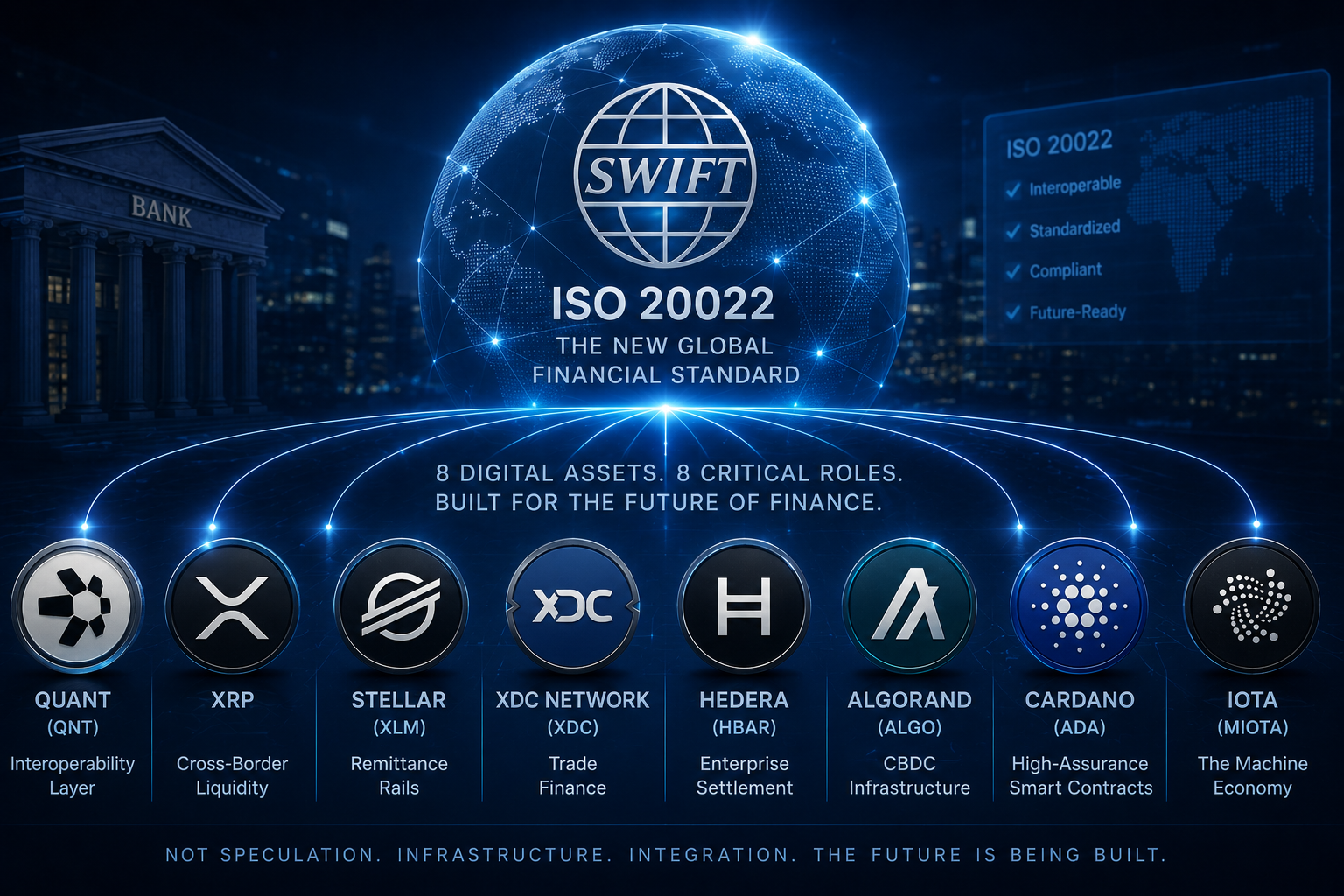
Here is how SWIFT’s ISO 20022 migration is redefining the utility of digital assets, and the eight specific networks positioned to become the core “plumbing” of global finance.
1. The Death of Legacy Banking Messages: Why ISO 20022 Matters
To understand why this is a game-changer, we have to look at how money actually moves across borders. Since 1977, banks have relied on SWIFT “MT” (Message Type) legacy formats. These messages were essentially unstructured text blocks, heavily constrained by character limits and prone to data truncation, human error, and manual compliance checks.
ISO 20022 completely rewrites this script.
Instead of basic text files, ISO 20022 utilizes a highly structured, machine-readable XML format. Every single data point—from the ultimate sender and receiver to the specific purpose of the payment—is cleanly tagged and separated. This structure allows legacy banking databases and modern distributed ledger technology (DLT) to communicate in the exact same language.
Rather than trying to destroy or replace traditional banking, the future of finance is about interoperability—seamlessly bridging public blockchains with regulated, sovereign central bank rails.
2. The Elite Eight: The Digital Assets Anchoring the New Standard
SWIFT has identified a select group of digital assets engineered specifically to handle the rich data, speed, and security requirements of the ISO 20022 framework.
Each of these eight assets is designed to solve a unique, structural bottleneck within the global financial system:
                  ┌────────────────────────────────────────┐
                  │          ISO 20022 BACKBONE            │
                  └───────────────────┬────────────────────┘
                                      │
          ┌───────────────────────────┼───────────────────────────┐
          ▼                           ▼                           ▼
    [ Liquidity ]              [ Interoperability ]        [ Trade Finance ]
  XRP (Cross-Border)          QNT (Network Bridge)        XDC (Supply Chain)
  XLM (Remittances)                                       HBAR (Settlement)
  ALGO (CBDC Rails)
┌ Quant (QNT): The Interoperability Layer
For the global banking system to function, different blockchains, legacy ledgers, and central bank digital currencies (CBDCs) must talk to each other. Quant’s Overledger API acts as the crucial translation layer, allowing enterprise systems to connect to multiple blockchains without changing their existing IT infrastructure.
┌ XRP: Cross-Border Liquidity
The traditional correspondent banking network requires institutions to pre-fund accounts (Nostro/Vostro) worldwide to facilitate international transfers—locking up trillions of dollars in idle capital. XRP acts as an on-demand bridge asset, converting local fiat to XRP and back in seconds to settle payments instantly.
┌ Stellar (XLM): Remittance Rails
Designed as a highly efficient, low-cost network, Stellar excels at micro-payments and retail remittance corridors, allowing individuals to send money globally for fractions of a penny.
┌ XDC Network (XDC): Trade Finance
The global trade finance sector relies on mountains of paper documents. XDC is optimized specifically to digitize these legacy instruments (like bills of lading and letters of credit), bringing the $20+ trillion trade finance market onto the blockchain.
┌ Hedera (HBAR): Enterprise Settlement
Utilizing its unique hashgraph consensus algorithm, Hedera provides the high throughput, fair transaction ordering, and real-time finality required for high-volume enterprise micro-payments and complex organizational settlements.
┌ Algorand (ALGO): CBDC Infrastructure
With its pure proof-of-stake consensus, Algorand is built to handle the high transactional speeds, safety, and instant block finality needed to support sovereign Central Bank Digital Currencies (CBDCs).
┌ Cardano (ADA): High-Assurance Smart Contracts
With its academic, peer-reviewed development methodology and highly secure smart contract architecture, Cardano is positioned to secure complex, multi-party financial agreements where security cannot be compromised.
┌ IOTA (MIOTA): The Machine Economy
As the Internet of Things (IoT) expands, machines will need to transact autonomously with one another. IOTA’s feeless “Tangle” architecture is built for microtransactions between connected devices, power grids, and automated supply chains.
3. High Switching Costs: The Ultimate Moat
In enterprise technology, the most valuable asset a network can have is high switching costs.
Once a massive global bank integrates a specific ledger or interoperability protocol into its core operating systems, the cost, effort, and risk of replacing that protocol is astronomical. It takes years of security audits, regulatory compliance checks, and software integration to adopt new financial plumbing.
Once these eight networks are thoroughly woven into the fabric of the ISO 20022 framework, they will be incredibly difficult to remove. This creates an unparalleled, long-term competitive moat that speculative, hype-driven memecoins simply cannot replicate.
4. The Strategy: Focus on the “Plumbing”
While retail traders spend their time monitoring short-term charts and chasing the next speculative wave, institutional “whales” are taking a much longer-term approach. Large-scale capital is quietly accumulating utility-driven, infrastructure-aligned assets—particularly key interoperability tokens like Quant (QNT)—in anticipation of their systemic roles.
For investors aiming to build sustainable, long-term wealth, the takeaway is clear: Look past the noise of the retail markets and focus on the assets that are actively becoming the plumbing of the next global financial standard. —