
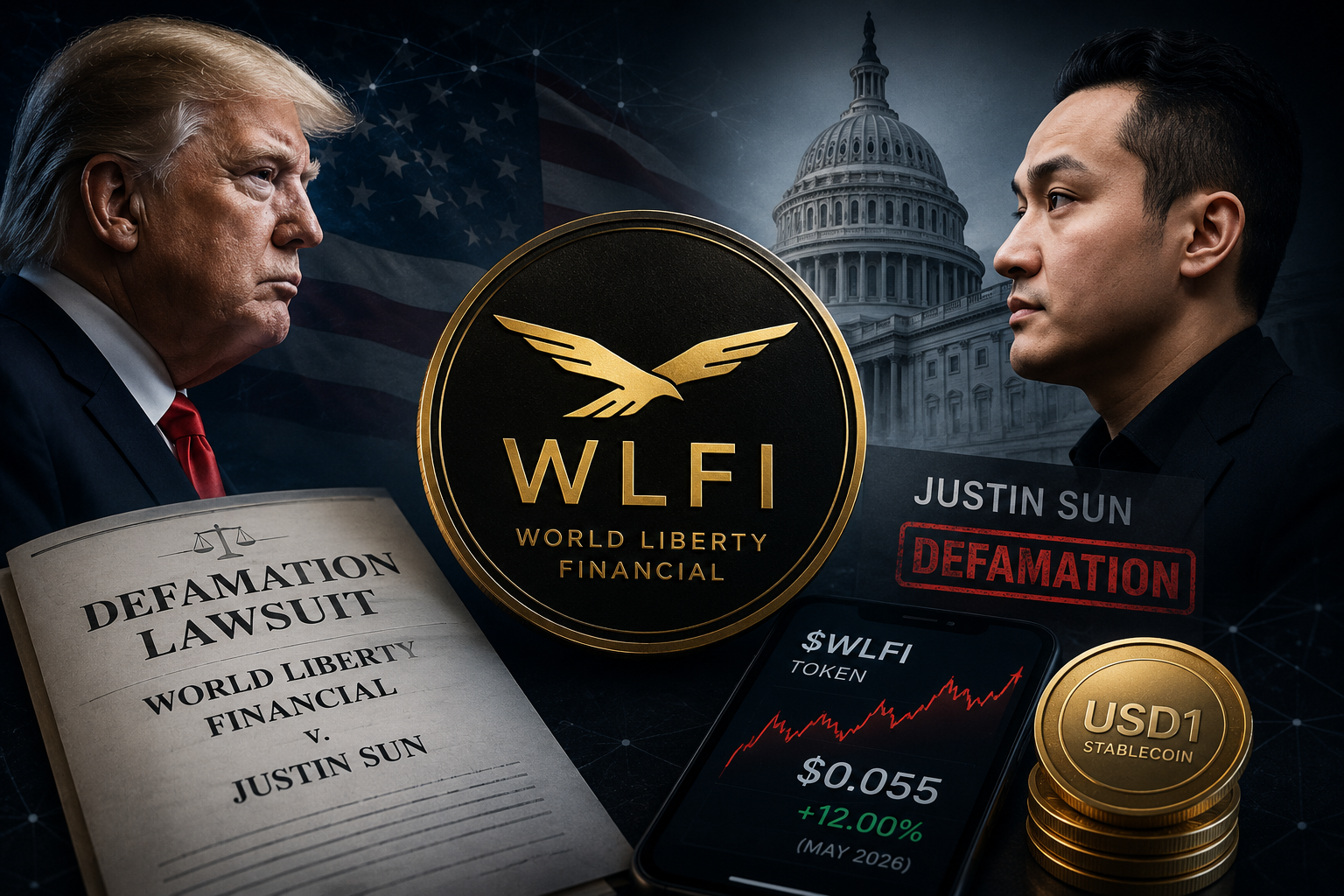
If you had “Donald Trump’s crypto venture sues a banana-eating crypto billionaire for defamation” on your 2026 bingo card, go ahead and collect your winnings.
We have officially entered a new era of decentralized drama. World Liberty Financial (WLFI)—the DeFi project backed heavily by Donald Trump, Donald Trump Jr., and Eric Trump—is locked in an absolute, scorched-earth legal war with TRON founder Justin Sun.
With WLFI filing a massive defamation lawsuit against Sun in Florida, Don Jr. and the team are working overtime to assure the public that the project is not falling apart. But in a space built on the code of “trust, but verify,” does the narrative actually hold water?
Let’s look at the facts, the lawsuits, and the massive red flags investors need to weigh.
The Backstory: From Best Buddies to Mutual Lawsuits
To understand why this project is suddenly in the headlines for all the wrong reasons, we have to look at how quickly a beautiful partnership went sour.
- The Honeymoon: Back in late 2024 and 2025, Justin Sun was WLFI’s knight in shining armor. He dumped a massive amount of capital into the project (buying between $30M and $45M worth of tokens) and was named an official adviser.
- The April Blowout: Fast forward to April 2026. Sun filed a lawsuit against WLFI, claiming the project committed fraud and breached their contract by unjustly freezing up to 4 billion of his tokens (valued at roughly $264 million), stripping him of voting rights, and threatening to permanently “burn” his holdings. He claimed the project is essentially a “scam” with backdoors.
- The May Counter-Punch: On May 4, 2026, WLFI clapped back with a defamation suit in Florida. They claim Sun is throwing a billionaire tantrum because they caught him violating their Terms of Service. They accuse Sun of making illegal “straw purchases” (buying tokens through third parties), violating lock-up agreements, and actively short selling $WLFI to crash the price.
Don Jr.’s Take: “It’s Just a Meritless PR Stunt”
With the $WLFI token trading at roughly $0.055 to $0.06—down roughly 80% from its initial high-water mark over the past year—the Trump family is in full damage-control mode.
Don Jr. and WLFI CEO Zach Witkoff have been loud and clear: The project is structurally sound, and Justin Sun is conducting a weaponized smear campaign. According to WLFI’s legal complaint, Sun has “weaponized his money and influence,” allegedly hiring online influencers and deploying fake social media bot accounts to tank the token’s price to extract hundreds of millions of dollars from the startup.
The Trump camp argues that the “freezing authority” Sun is complaining about is not a secret “trap door”—it is explicitly written into the smart contracts and the Terms of Sale that Sun himself signed.
The Red Flags: Do We Believe the Hype?
So, is WLFI actually “falling apart,” or is this just a temporary bump in the road caused by an angry ex-partner?
If you look past the courtroom drama, several structural realities should make any crypto investor pause:
1. Centralization in “DeFi” Clothing
The biggest irony of World Liberty Financial is its claim to represent “decentralized finance.” If a project’s core team can unilaterally freeze hundreds of millions of dollars worth of tokens belonging to their largest investor, it is not decentralized. While WLFI legally defended this as an essential security measure to “protect the ecosystem” from Sun’s alleged rules violations, it highlights a stark reality: a few large wallets and administrators hold ultimate control.
2. The Trump Family “ATM” Accusation
One of the statements WLFI is suing Sun over is his public accusation on X that the platform “treats the crypto community as a personal ATM.”
While Sun’s phrasing is aggressive, public corporate filings do show that 75% of net protocol revenues are slated to be routed to the Trump family (via DT Marks DE-FI AM LLC). For purists in the crypto space, a project where three-quarters of the fees go directly to a political family rather than being reinvested into the protocol’s liquidity or development is a tough pill to swallow.
3. The Stablecoin Pivot (USD1)
Despite the chaos, WLFI is charging forward. They recently closed private rounds selling an additional 5.9 billion tokens, bringing total fundraising to over $550 million. They are also aggressively developing USD1, a blockchain-based US dollar stablecoin, and a broader DeFi lending platform designed to bridge traditional finance with blockchain.
But launching a stablecoin into an incredibly crowded market (dominated by USDT and USDC) while your brand is radioactive with legal battles is an uphill battle, to say the least.
The Verdict: A High-Beta Soap Opera
So, do we believe Don Jr. when he says the project isn’t falling apart?
The project isn’t dead yet—but it is highly dysfunctional. WLFI has plenty of cash in the war chest thanks to their massive token sales, and their political connections mean they will continue to get meetings with top-tier financial institutions (like their Mar-a-Lago forum earlier this year with the CEOs of Goldman Sachs and Franklin Templeton).
However, the $WLFI token itself is currently behaving less like a utility asset and more like a high-beta meme token tied directly to political headlines and legal filings. Until the legal warfare with Justin Sun is settled and the team proves that the USD1 stablecoin actually has organic, institutional demand, WLFI remains a highly centralized, high-risk soap opera.
Are you holding $WLFI through the storm, or is the centralization a dealbreaker for you? Let’s talk about it in the comments below!